
Every time we send an email, a WhatsApp message, make a click or buy something online, we are generating data. We also generate data when we post a tweet or update our Facebook status. Moreover, there are already more than 3.2 billion Internet users in the world, a figure that triples every 9 years. There are also more than 1.75 billion smartphone users. Therefore, we are talking about gigantic amounts of data. So, what does it take to become a data professional?
Fortunately, the exponential increase in the amount of data has been accompanied by a parallel advance. In other words, the capacity to collect, organize, process and analyze data has grown. The cost of data storage keeps getting cheaper. In addition, processing power is now several multiples of what it was just a few years ago. The tools for handling data are more accessible than ever. In fact, we already speak of zettabytes of data available for extracting business intelligence. We have seen several examples of this in other articles. For instance, data analysis has made it possible to predict stock market behaviour, box office hits or prevent fires. It has also served to select more profitable baseball players.
A sector with demand for professionals
All the necessary processing work requires an army of data experts. Translation: there has never been a better time to pursue a career related to data. However, the ICT sector is going to run a deficit. For example, in Spain alone, 15% of large companies had difficulty finding specialists in 2020. Furthermore, nearly 1.39 million additional specialists are estimated to be needed to meet the goals of the EU’s Digital Decade. Therefore, the first step to becoming a data wizard is to identify the most suitable career path.
Data Analyst
A data analyst is essentially a junior data scientist. It is the entry-level position in a Data-related career. For example, analysts do not have the research background or the advanced mathematics knowledge to invent new Machine Learning algorithms. However, they must have an understanding of how to use the tools to solve business problems.
Skills and tools
Data analysts must have a foundation of technical skills and knowledge. For example, in programming, statistics, machine learning, data munging and data visualization. In addition to technical skills, they must be meticulous about details. They also need the ability to present results clearly and concisely. With time, dedication and support from more experienced analysts, they must be able to acquire, process and summarize data sets.
Likewise, data analysts are responsible for managing the quality control of data scraping. They normally run the queries needed by any department in the company. Then, they solve data-related problems by scaling and prioritizing resources. Finally, this professional profile is in charge of packaging the data to present the intelligence extracted from the information. This way, the presentation becomes a narrative or a visual that colleagues from other non-data-expert areas can understand.
Professionals who follow this path should feel passionate about data exploration, learning data mosaics, database theory, languages such as JavaScript, or data visualization.
Professional Data Scientist
Data analysts and data scientists share the same goal in the company: obtaining intelligence and insights from the available data lakes. However, the work of data scientists requires especially sophisticated skills. For example, they must handle both the volume and the velocity of data. A data scientist must be able to carry out undirected research and even formulate complex questions and problems. Moreover, data scientists usually hold degrees in quantitative fields such as computer science, physics, statistics or applied mathematics. As a result, they have the knowledge to invent algorithms that solve problems with data.
These data scientists are extremely valuable to the companies that hire them. For example, they can uncover new business opportunities or save the company a lot of money by identifying patterns in the data. Thus, by highlighting customer behaviours, they can help identify potential fraud. They can also predict which products are going to be more successful so the company can be prepared in terms of stock.
Skills and tools
A data scientist must explore data from different angles and be able to extract data from various sources. They use tools such as Hadoop (the most widespread file system framework for distributed data processing). In addition, they use programming languages such as Python or R. They also apply fundamental practices of statistics, probability, model building and advanced mathematics.
The set of skills required varies depending on the company and the project. For example, Data Science London published a diagram of the tools of a professional data scientist. This shows how complex it can get.
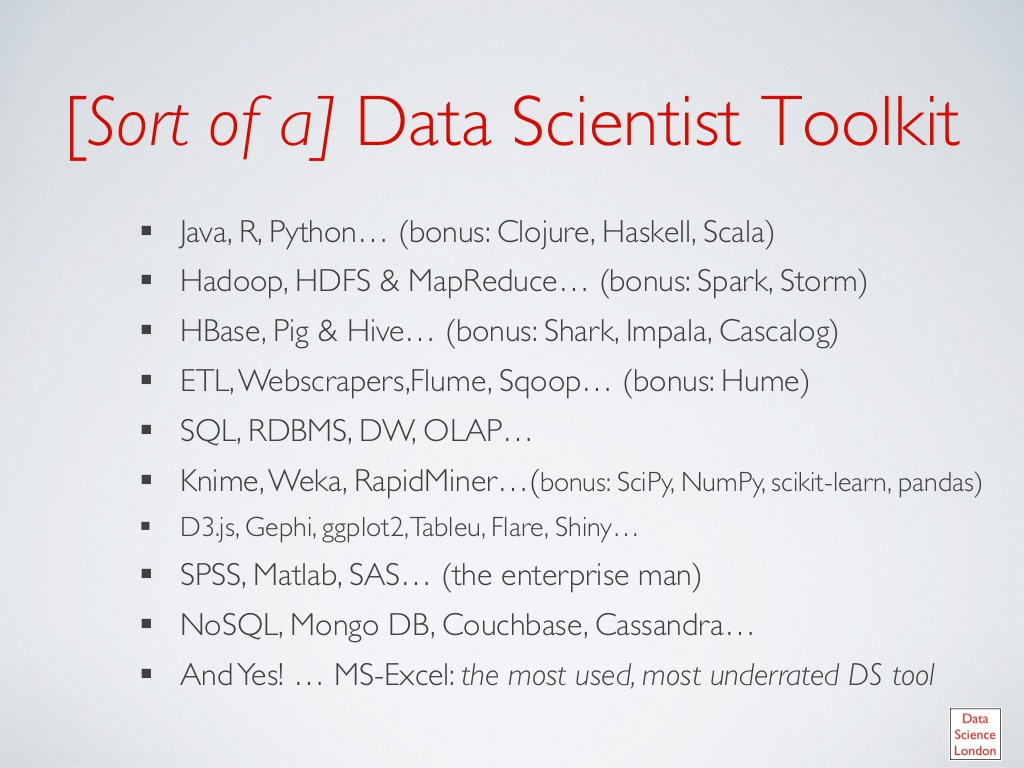
Image via Data Science London
The most valuable non-technical skill a data scientist can bring is immense curiosity. These professionals must be obsessed with formulating hypotheses. Then, those hypotheses must result in solutions supported by the information extracted. This way, they enable the transformation of their business.
I love the power of metrics and tracking user behaviour because it gives me the opportunity to test personal intuitions and then get empirical results that allow our team to make data-driven decisions and thus continuously improve our product Gaëlle Recourcé, CSO at Evercontact
In essence, data scientists leverage data to solve business problems. They interpret, extrapolate and prescribe from data to facilitate actionable recommendations. For example, a data analyst produces summaries of what has happened. In contrast, a data scientist develops strategies to predict the future. Over time, they usually specialize in a specific area.
Data scientists must identify exactly how to optimize online businesses to retain the best customers. They must also know how to launch products to capture the greatest value in the customer lifecycle. Finally, they must know how to adjust distribution processes to achieve the best times with the lowest costs and losses.
Professional Data Engineer
A data engineer is capable of building data pipelines in robust, fault-tolerant architectures. Those architectures sustain, clean, transform and aggregate different data sources into database blends. Data engineers are usually software engineers. In addition, they are responsible for compiling and installing distributed and parallel processing systems. They also create databases and program complex queries. Finally, they carry out multi-machine scaling and keep data recovery systems up to date.
Data engineers essentially lay the foundations. This way, data analysts or data scientists can easily access the data sets they need for review and experiment formulation.
Skills and tools
While data analysts are in charge of extracting value from data, data engineers do different work. Specifically, they ensure data flows seamlessly from sources to destinations. This way, the system can process it. Therefore, data engineers must have deep knowledge and experience in the following technologies:
- Hadoop-based technologies such as MapReduce, Cassandra, Hive or Pig.
- In addition, SQL-based technologies such as PostgreSQL or MySQL
- NoSQL-based technologies such as Cassandra or MongoDB
- Data Warehousing solutions
my responsibilities range from designing the system architecture and its modules to implementing the algorithms and the infrastructure requirements Dmitry Novikov, Data Engineer
Data engineers handle the behind-the-scenes work, which usually goes unseen. However, without that work, the rest of the team could not do theirs. For example, this infographic shows the differences between data engineers and data scientists.
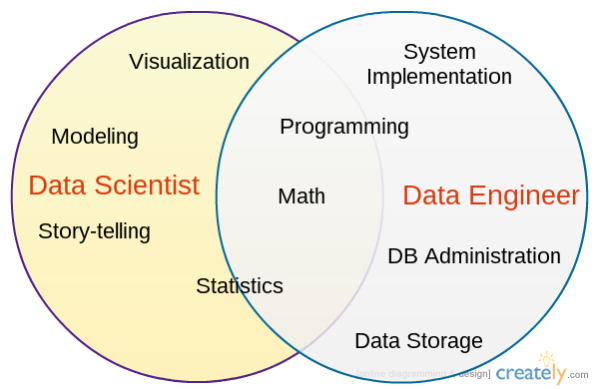
Image via Data Science 101
Chris Beland leads the data engineering team at Allclasses. He then describes what his team does, why it is important and why he loves it:
“In my daily work, I do a lot of NLP (natural language processing), turning semi-structured web content that is comprehensible to humans into highly structured, machine-comprehensible content stored in databases. What I enjoy most is teaching machines something concrete about the real world. For example, how humans write calendar dates and what they mean, or how the universe of topics can be broken down into categories and subcategories.
That is when we create algorithms so the system can exploit that new knowledge. This way, the system can analyze and classify texts and make sense of them much like a human would. I feel a bit like a proud father when I see how the resulting database gives the program a virtual nudge to get all the right answers, despite dealing with a huge amount of unexpected inputs. And with one click, the results go out to the people who need them.”
There are many options when it comes to taking the data-related career path. If you are interested in working in big data professionally, three profiles are in demand: data analyst, data scientist and data engineer.
Data processing professionals have split into three more specialized disciplines. For example, specialization happened in other fields such as medicine: we now have general practitioners, surgeons and neurosurgeons. The same has happened with data.
Do you want to train as a data professional and grow on projects that matter? At BAOSS we are looking for data, AI, cloud, development and cybersecurity profiles to work with leading clients in banking, retail, healthcare and the public sector, alongside partners such as IBM, Red Hat, Anthropic and Google. Work with us and send us your CV.
Prefer to talk to us directly? Contact the BAOSS team and tell us about your challenge.
Related articles: AI in 2026 Is Won in the Data: Data Maturity First, Intelligence Later.