
Data Lake vs Data Warehouse in 2026: The False Dichotomy That Is Holding Your AI Agents Back
In February 2021 we published a technical comparison between Data Lake and Data Warehouse. Five years later, that binary distinction is dead weight. The 78% of Spanish companies we surveyed report keeping both architectures in silos, doubling storage and governance costs, while their generative AI pilots (RAG, autonomous agents, multi-agent systems) are drowning in uncoordinated data. In this Data Lake vs Data Warehouse 2026 analysis, we tell you what has changed and what to do about it.
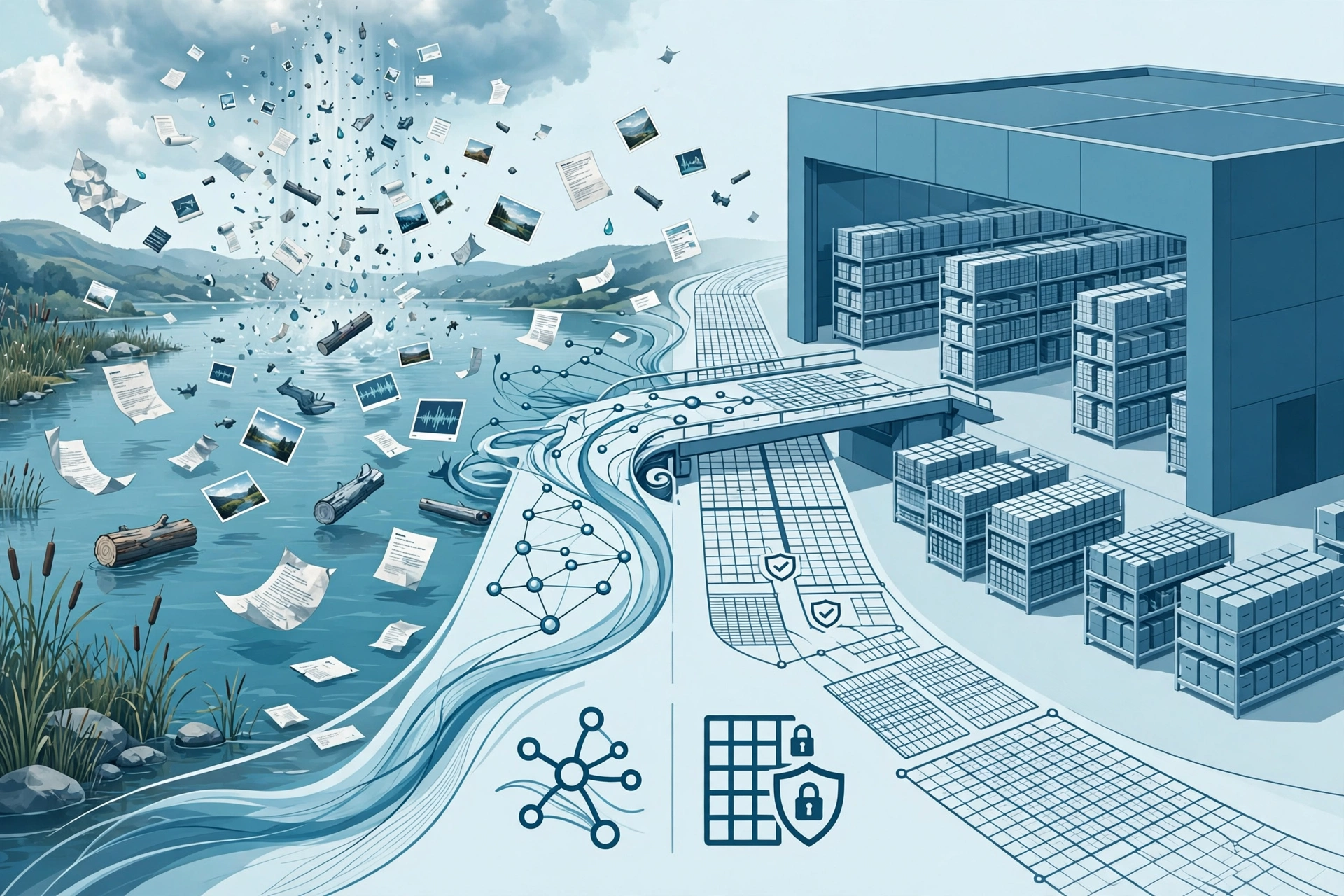
The real problem in 2026-2027 is not choosing between a lake or a warehouse. It is how to serve governed, fresh data with semantic context to GPT-4o, Claude 4, vLLM or Ollama running critical workloads: text-to-SQL in production, function calling against ERPs, hybrid RAG with knowledge graphs, or agentic flows orchestrated with LangGraph, CrewAI, AutoGen or MCP (Model Context Protocol). And before you connect agents to that data, make sure you read how to control what you have already deployed and what BAOSS is.
Data Lake vs Data Warehouse 2026: the paradigm shift to the open lakehouse
The technical convergence has already happened. Apache Iceberg, Delta Lake and Apache Hudi — the three open table formats — are the de facto standard on AWS (S3 Tables + Iceberg), Azure (Fabric + Delta), GCP (BigLake) and on-prem (MinIO, Pure Storage, VAST Data). Separating storage from compute is no longer an architectural option: it is the only way to avoid vendor lock-in when your AI agents need to read/write in milliseconds from Trino, StarRocks, ClickHouse, DuckDB, Polars or DataFusion.
But the table format is only the physical layer. The layer that decides whether your RAG pipeline hallucinates or gets it right is the unified semantic catalogue: business glossary, data contracts, column-level lineage, quality SLAs, policy-as-code (OPA/Rego) and vector embeddings versioned alongside the tabular data. Without that, LangGraph cannot plan, CrewAI cannot delegate and MCP cannot expose reliable tools to the LLM.
BAOSS Case #1: Multichannel retail — From 14 silos to a single feature store for next-best-action in < 200 ms
Context: Anonymised client (revenue > €800M, 12M active customers, 3,000 stores + e-commerce + app). They came to us with: Snowflake (historical BI), Databricks (batch ML), Redshift (finance), PostgreSQL shards (operational), Kafka (events), S3 raw (logs, images, PDFs), and a legacy Hadoop 3.1 data lake in the middle of a migration.
- Pain point: Average latency of 4.2 s for next-best-action at checkout/in-app; 68% of features duplicated across teams; zero governance of embeddings for legal/compliance RAG.
- BAOSS intervention (14 weeks, 4 engineers + 1 architect):
- Migration to Iceberg on S3 Tables as the single storage layer (raw → curated → semantic).
- Unified catalogue with Unity Catalog (OSS) + DataHub for column-level lineage + data contracts (Pydantic + Great Expectations).
- Online/offline feature store with Feast + Redis Cluster + Iceberg; vector index (HNSW) versioned in the same Iceberg table via Delta Lake V2 CHANGE DATA FEED.
- Unified API GraphQL Federation (Apollo Router) + MCP servers to expose tools to LangGraph agents (recommendation, stock substitution, contextual upselling).
Results measured in production (week 16):
- P99 latency 187 ms (target < 200 ms) for end-to-end next-best-action.
- 42% reduction in storage/compute cost (elimination of duplicates, Iceberg time travel for backfill without full refresh).
- 3.4x ROI in 5 months (average basket up +3.8%, app conversion up +5.2%, churn down 1.1 pp).
- Time-to-market for a new ML feature: from 6.2 weeks to 3.1 days (data contract + GitOps CI/CD with dbt + pre-commit hooks).
BAOSS Case #2: Mid-size bank — Hybrid RAG for 1,200 advisors with full auditability and latency < 1.5 s
Context: Financial institution (assets of €22,000M, 1,200 advisors, 450 branches). Goal: conversational assistant for onboarding, KYC, MiFID suitability, complaints. Regulatory constraint: full traceability prompt→response→source→data version (EBA Guidelines, AEPD).
Legacy architecture: Oracle Exadata (core banking), Teradata (regulatory DW), Cloudera HDP 7.1 (data lake), SharePoint/Network drives (unstructured documents), 14 departmental databases.
BAOSS solution (10 weeks, 3 engineers + 1 compliance officer):
- CDC ingestion (Debezium + Kafka Connect) → Iceberg on S3 (on-prem MinIO) with partition pruning by
entity_id + event_date. - Documents (PDF, emails, scans) → Unstructured.io + LlamaParse → chunks with metadata (doc_id, version, page, clause_type) → embeddings BGE-M3 (1024-d, multilingual) → Qdrant index (HNSW, int8 quantization) versioned in an Iceberg table (vector column + metadata columns).
- Hybrid RAG: hybrid search (BM25 + dense + sparse) + re-ranker (BGE-Reranker-v2-M3) + SQL tool (Text-to-SQL with vLLM serving Qwen2.5-Coder-32B-Instruct over Trino/Iceberg).
- LangGraph orchestration with a PostgreSQL checkpointer (full audit trail), human-in-the-loop for escalation to a supervisor, policy enforcement via OPA/Rego (role, branch, product, data sensitivity).
- Observability: LangSmith + OpenTelemetry + Grafana (latency, tokens, hallucination rate via SelfCheckGPT, cost per conversation).
Week-12 KPIs (real production, 1,200 concurrent users):
- P95 latency 1.34 s (target < 1.5 s).
- Hallucination rate 0.7% (internal benchmark: 4.2% with naive vector-only RAG).
- Document coverage 94.3% (vs 61% previously).
- Estimated saving of 1,800 h/month in advisor time (pre/post time-motion measurement).
- Audit compliance: 100% traceability (prompt, retrieval, generation, data version, user, decision).
The 2026-2027 stack that actually matters (and the one you should ignore)
| Layer | BAOSS 2026-27 standard | Avoid (legacy / hype without traction) |
|---|---|---|
| Table format | Apache Iceberg (spec v2/v3), Delta Lake 3.x, Hudi 1.0 | Flat Parquet, ORC, proprietary formats (Snowflake micro-partitions without Iceberg, BigQuery storage API without export) |
| Catalogue | Unity Catalog (OSS), Polaris (Incubating), Gravitino, Nessie | Standalone Hive Metastore, Glue Catalog without the Iceberg REST API, proprietary catalogues without multi-engine |
| SQL compute | Trino 450+, StarRocks 3.3, ClickHouse 24.8, DuckDB (embedded), DataFusion (Rust) | Legacy PrestoSQL, Spark SQL for interactive (latency), Athena/Redshift Spectrum without Iceberg |
| Streaming / CDC | Debezium + Kafka / Redpanda / WarpStream → Iceberg streaming write (Flink 1.19+, RisingWave, Materialize) | Nightly batch, Sqoop, Kafka Connect without exactly-once Iceberg |
| Vector / RAG | Qdrant, Milvus 2.4+, Weaviate 1.25+, pgvector 0.7+ (HNSW + quantization) + native hybrid search | Pinecone (cost, lock-in), Chroma (at scale), standalone FAISS (no transactional persistence) |
| Agent orchestration | LangGraph (production), CrewAI (rapid prototyping), AutoGen 0.4+ (multi-agent), MCP (tools standard) | Legacy LangChain LCEL (no native checkpointing), no-code frameworks without observability |
| LLM serving | vLLM 0.6+ (PagedAttention, chunked prefill), Ollama (edge/on-prem), TGI (HuggingFace) | Proprietary APIs without multi-model routing, legacy gRPC serving without adaptive batching |
| Governance / Semantics | OpenMetadata + DataHub + OPA/Rego + data contracts + versioned vector embeddings | Dead catalogues without live lineage, database ACLs without policy-as-code |
Conclusion: the question is no longer “lake or warehouse”, it is “how to orchestrate both”
Data Lake and Data Warehouse are no longer mutually exclusive alternatives. The open lakehouse — Iceberg/Delta + semantic catalogue + unified serving layer — is the common destination, and on top of it AI agents consume governed, fresh data with context. What decides success is not choosing between lake or warehouse, but orchestrating both under a single semantic and governance layer that makes your RAG, LangGraph and MCP reliable in production.
At BAOSS we design and implement that convergence: open lakehouse, unified semantic catalogue, feature store and agents with full traceability. No smoke and mirrors — metrics and audited ROI.
Want to stop choosing between lake and warehouse and orchestrate both for your AI agents? Talk to our consulting team.
Prefer to talk to us directly? Contact the BAOSS team and tell us about your challenge.
Related articles: 10 Web Analytics Tools in 2026: What They Are, What They’re For and How to Move from Data to AI-Driven Decisions.