

In June 2015 we published an introduction to Apache Hadoop right here on this blog. The title was simple: “What Is Apache Hadoop?” Ten years later, the question is no longer what Hadoop is, but how to get out of it without stopping the business.
The ecosystem that was built to deliver cheap, massive storage and processing (HDFS + MapReduce) has become public enemy number one for organizations that want to operate with generative AI, autonomous agents and real-time data. At BAOSS we have walked six enterprise clients through full migrations in 2026-2027, moving from on-premise Hadoop 2.x/3.x clusters to open lakehouse architectures (Iceberg, Delta Lake, Hudi) on Kubernetes and hybrid cloud. The patterns keep repeating: runaway operating cost, 8-12 years of accumulated technical debt, and the impossibility of serving features to LLM models (GPT-4o, Claude 4, Llama 3.1 405B) with sub-second latency.

The Real Problem in 2026: Hadoop Was Not Built for the Age of AI Agents
Hadoop’s original architecture assumes batch processing of static data. The 2026-2027 paradigm demands the opposite: data in motion feeding autonomous agents that reason, act and learn in closed loops (LangGraph, CrewAI, AutoGen, Semantic Kernel).
- Structural latency: the single NameNode (even with HA) and HDFS cannot deliver strong consistency under massive concurrent reads. RAG pipelines that query vector stores (pgvector, Milvus, Weaviate, Qdrant) need freshness measured in seconds, not hours of overnight ETL.
- Fragmented governance: Ranger + Atlas cover basic authorization and lineage, but they do not solve versioned data contracts, automated quality gates (Great Expectations, Soda Core) or end-to-end column-level lineage all the way to the LLM prompt.
- Hidden maintenance cost: a 100-node on-premise cluster (a typical Spanish enterprise setup) costs €1.2-1.8M per year across hardware, Cloudera/CDP licenses, power, cooling and 3-4 specialized FTEs. 68% of that spend goes to “keeping the lights on,” not innovation (Gartner 2024 data + BAOSS projects).
- Critical talent gap: MapReduce/Hive/Pig developers are a scarce and expensive profile. The new generation of data engineers works with dbt, SQLMesh, Dagster, Airflow 2.9+, Polars, DuckDB and LLM vendor SDKs (OpenAI, Anthropic, Vertex AI, Bedrock, Ollama/vLLM for local inference).
A banking client (anonymized, 12 PB raw, 3 CDH 6.3 clusters) was measuring 14 days of lead time from the moment the business asked for a new risk-scoring feature until the data was actually available to the model. After modernization: 4 hours, via data contracts + CI/CD + a feature store (Feast) + a serving layer (Trino + Iceberg).
The Target Architecture 2026-2027: Open Lakehouse + Native AI
There is no one-size-fits-all, but the winning pattern in our projects combines:
- Open table format: Apache Iceberg (largest enterprise adoption, native support in Trino, Spark, Flink, Dremio, Snowflake, BigQuery, Redshift). Delta Lake if the client is already on Databricks. Hudi for heavy streaming (massive CDC upserts).
- Federated query engine: Trino/Starburst as the single SQL layer for BI (Superset, Metabase, Power BI), data science (Jupyter, VS Code) and RAG retrieval (text-to-SQL with GPT-4o/Claude 4 → Trino → vector store).
- Unified catalog: Nessie (git-for-data), Polaris (incubating), Unity Catalog (open-sourced in 2024) or Gravitino. Governs Iceberg/Delta/Hudi + schemas + tags + access policies in a single plane.
- Declarative orchestration: Dagster or Airflow 2.9+ with data assets and partitions defined as code. The 2015-style spaghetti DAGs are gone.
- Semantic layer + AI: Cube.dev or the dbt Semantic Layer exposes certified metrics to agents (LangGraph tools, CrewAI tools, MCP servers). The LLM no longer hallucinates column names: it queries the semantic catalog via function calling.
This stack runs on Kubernetes (EKS, AKS, GKE, OpenShift, Rancher) with native operators (Strimzi for Kafka, Spark Operator, Trino Operator, Iceberg REST Catalog). The client chooses cloud, on-prem or hybrid with no format-level vendor lock-in.
The Migration Strategy: “Strangler Fig” by Domain, Not Big Bang
The classic mistake is trying to migrate the whole cluster at once. At BAOSS we apply the Strangler Fig pattern per data domain (Customer 360, Risk, Marketing, Supply Chain, Finance). Each domain follows 4 phases:
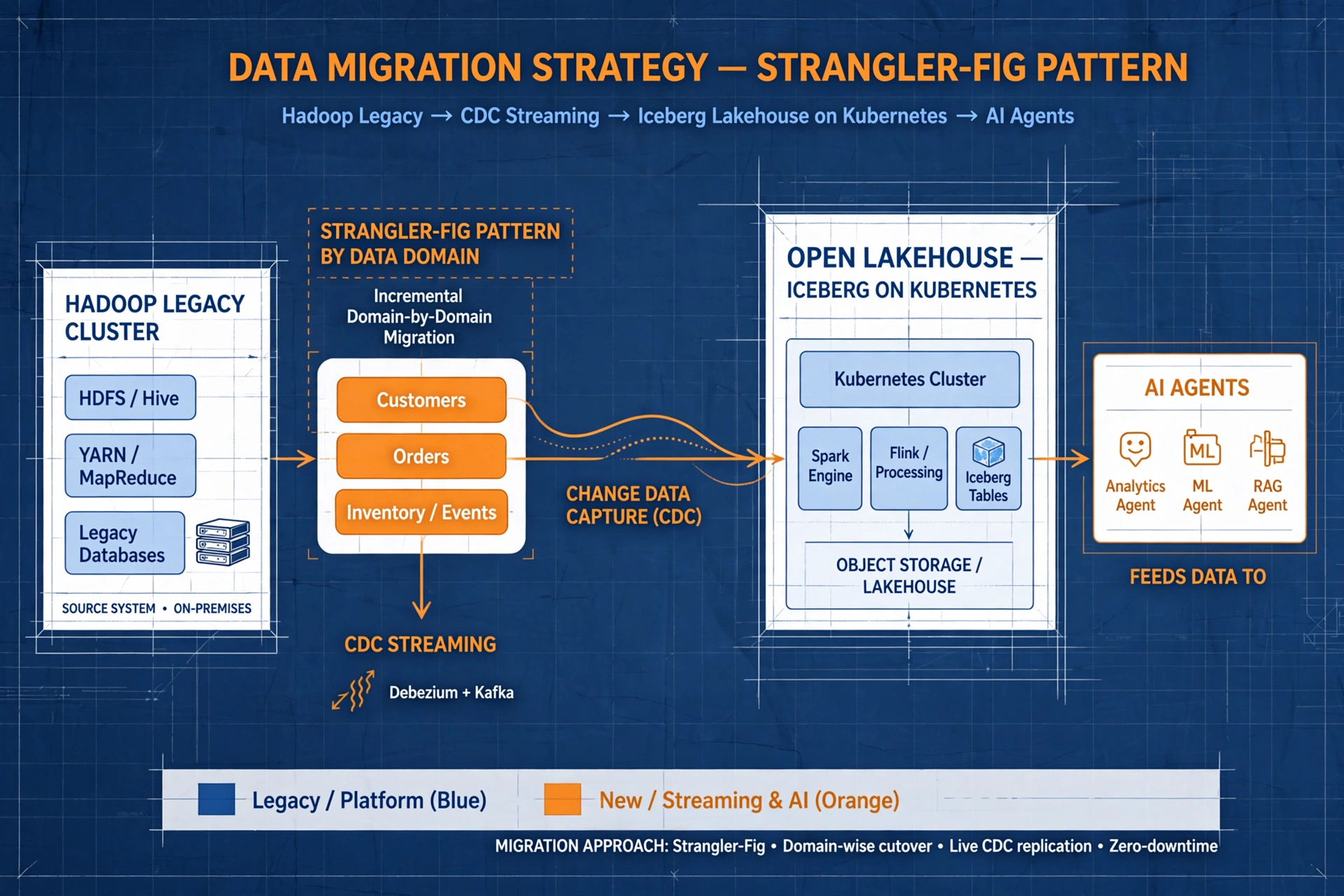
- Discovery & Contracting (2-3 weeks): automated profiling (DataHub + Great Expectations), definition of data contracts (Pydantic/Avro/Protobuf) agreed with consumers (data scientists, analysts, AI agents). Output: a catalog of versioned data products.
- Dual Write + Validation (4-6 weeks): CDC (Debezium + Kafka/Redpanda) replicates Hive/HBase changes → Iceberg in real time. Parallel pipelines (legacy + new) with automated data diff (data-diff, dbt-audit-helper). Exit metric: < 0.1% row/column discrepancy.
- Progressive cutover (2-3 weeks): feature flags in the consumption layer (Trino views, dbt models, API Gateway). Consumers migrate one by one. Instant rollback. Zero downtime.
- Decommissioning & Optimization (ongoing): shutting down Hadoop nodes and freeing up CAPEX/OPEX. FinOps: rightsizing Trino workers, Iceberg compaction policies, partition pruning. Goal: 40-55% total cost reduction versus the Hadoop baseline.
Real-world case (retail, 8 PB, 450 TB/day of ingestion): the “Customer 360” domain was migrated in 11 weeks. 3.2x ROI in 6 months (savings on Cloudera licenses + FTEs + time-to-insight). The “Supply Chain” domain is now underway, reusing 80% of the components (catalog, CDC, quality, orchestration).
The AI Factor: Why 2026 Is the Point of No Return
The 2023-2024 GenAI pilots (internal chatbots, document summarization) have proven their value. The 2026-2027 wave is agentic AI in production: multi-agent systems that query data, execute actions (API, SQL, workflows) and close decision loops with no human in the loop (human-on-the-loop for critical validation).
Examples we are deploying for BAOSS clients:
- Financial reconciliation agent (LangGraph + Trino + Iceberg): receives bank statements as PDF/CSV → extracts transactions (GPT-4o vision) → matches them against the ledger (fuzzy SQL join) → proposes journal entries → the human validates → approves → posts. 87% reduction in manual time, 0 accounting errors in 3 months.
- Multi-warehouse stock optimization agent (CrewAI + Flink + Iceberg + vLLM/Llama 3.1 70B local): predicts demand (forecasting model) → simulates redistribution (RL agent) → executes transfer orders (ERP API) → monitors stockout/overstock KPIs. 4.1x ROI in year 1.
- Enterprise RAG with governance (MCP server + Trino + pgvector + Unity Catalog): 12,000 technical documents + 400 Iceberg tables. The agent answers engineers’ queries with exact citations (table, column, row, document, page). 92% adoption across the engineering team in 8 weeks.
None of these use cases work on legacy Hadoop. They require sub-second latency, versioned schemas, column-level lineage and open APIs (REST, GraphQL, MCP) so the agent can discover and consume data autonomously.
Recommended Tech Stack 2026-2027 (BAOSS Version)
| Layer | Primary choice | Alternative | Why |
|---|---|---|---|
| Table format | Apache Iceberg | Delta Lake / Hudi | Open, multi-engine, time travel, partition evolution, broad vendor support |
| Catalog | Nessie / Polaris / Unity Catalog | Gravitino / Hive Metastore (legacy only) | Git-for-data, multi-table transactions, fine-grained RBAC/ABAC |
| SQL engine | Trino / Starburst | Dremio / Spark SQL / DuckDB (local) | Native federation, cost-based optimizer, connector ecosystem, Kubernetes native |
| Streaming / CDC | Kafka / Redpanda + Debezium + Flink SQL | RisingWave / Materialize | Maturity, exactly-once, SQL streaming, native Iceberg sink |
| Orchestration | Dagster / Airflow 2.9+ | Prefect / Temporal | Asset-based, data contracts, partitioning, CI/CD friendly |
| Quality / Contracts | Great Expectations / Soda Core + dbt contracts | Data Contracts CLI / Pydantic | Tests as code, CI integration, alerting |
| Semantic layer | Cube.dev / dbt Semantic Layer | AtScale / Kyvos | Headless BI, GraphQL/REST/SQL API, multi-tenant, intelligent caching |
| Vector store | pgvector / Qdrant / Milvus | Weaviate / Chroma / Pinecone | pgvector simplifies the stack with PostgreSQL; Qdrant/Milvus for >100M-vector scale |
| LLM inference | vLLM / Ollama / TGI (self-hosted) + OpenAI/Anthropic/Vertex/Bedrock APIs | Lambda / RunPod / Together | Data control, fixed cost, predictable latency; hybrid for spikes |
| Agent framework | LangGraph / CrewAI / AutoGen / Semantic Kernel | LlamaIndex Agents / Haystack | Stateful graphs, human-in-the-loop, tool calling, multi-agent orchestration |
| Observability | OpenTelemetry + Grafana + Loki + Tempo | — | End-to-end traceability of flows and agents |
Conclusion
Apache Hadoop fulfilled its mission: it was the standard that democratized big data processing. But it was born for a world of batch and static data, not for feeding AI agents that decide and act in milliseconds. Keeping it running today means burning budget on “keeping the lights on” while your competitors serve features to their models in hours.
The way out is not a big bang but an incremental, domain-by-domain migration to an open lakehouse on Kubernetes, with real-time CDC, data contracts and AI agents consuming governed data. It is a proven path with measurable ROI, without stopping the business.
At BAOSS we have modernized six enterprise clusters using this pattern, cutting data lead time from days to hours and reducing total cost by 40% to 55%. If your Hadoop is becoming a burden, let’s talk.
Request your data modernization assessment and discover the ROI of moving off Hadoop →