
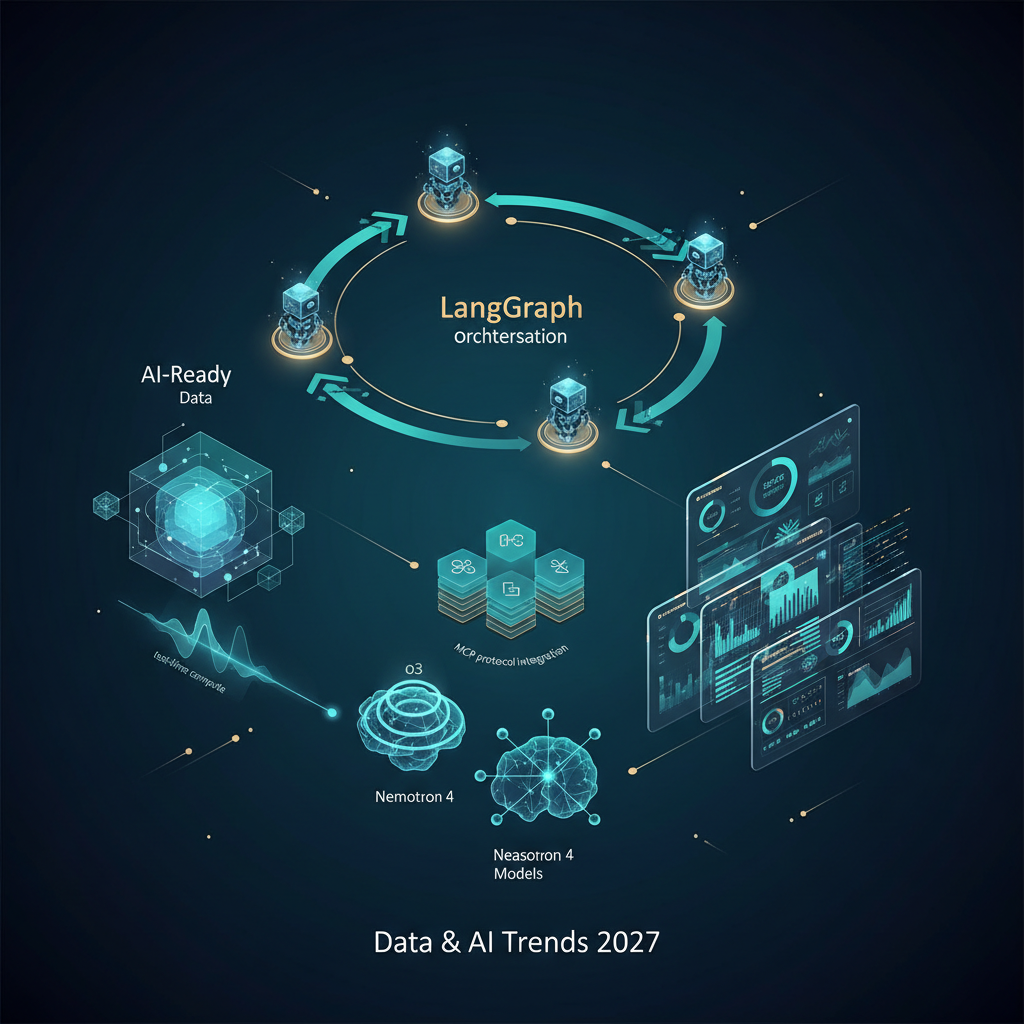
January 2017. We published our first Big Data trends analysis. Hadoop was turning ten, Spark was displacing MapReduce, and Tableau lost half its stock value in a single day. Ten years later, the landscape has not changed: it has inverted. The 2026-2027 problem was generative AI pilot purgatory. In contrast, the 2027 problem is scaling autonomous agents with governance, predictable cost and measurable ROI in massive production. These are the Data Trends 2027 already defining that leap.
At BAOSS we have accompanied more than 60 organisations in 2026-2027 in the leap from pilots to Agentic Operations. The 2027 pattern is clear: the companies that win do not have “better models”. On the contrary, they have decision architectures that operate 24/7 without constant human supervision. Moreover, they have full traceability for the AI Act and ISO 42001, and cost per decision under control.
Data Trends 2027: the 5 that define the year
1. Agentic Operations: from “co-pilot” to a governed “autopilot”
2026-2027 was the year of human-in-the-loop. In contrast, 2027 is the year of human-on-the-loop: agents that operate autonomously within defined decision windows (pricing, risk, allocation, maintenance). These agents apply hard guardrails (financial, regulatory and safety limits). They also escalate to a human automatically only when uncertainty exceeds quantified thresholds. The risk of not making the change is real: is your company exposed to the disruption shock?
BAOSS 2027 metric: clients in massive production report 85-95% autonomous decisions (vs 60-70% in 2026). Moreover, the escalation rate is < 5% and autonomous time-to-resolution is < 200ms.
- Architecture: LangGraph + persistent checkpointer (PostgreSQL/Redis) + native time-travel debugging.
- Governance: Versioned OPA/Cedar policies + immutable audit log (OpenLineage + Kafka) + 1-click rollback.
- Key KPI: Autonomy Rate = autonomous decisions / total decisions; target > 90% in mature domains.
2. Reasoning models (o1/o3, Nemotron 4 Ultra, Qwen3) + test-time compute
The race is no longer pre-training. It is now test-time compute: models that “think” more before answering (internal Chain-of-Thought, self-consistency, tree search). Therefore, in 2027 inference cost shifts from output tokens to internal reasoning tokens.
Architectural implication: intelligent routing by complexity is applied. Simple tasks go to small/distilled models (Llama-3.3-8B, Nemotron 3 Ultra 8B). Complex tasks (planning, debugging, compliance) go, on the other hand, to reasoning models (o3, Nemotron 4 Ultra, Qwen3-72B). Each use case defines its budget of reasoning tokens.
- BAOSS case (banking, 2026): compliance agent migration from GPT-4o → Nemotron 4 Ultra (vLLM, 8×H100). Inference cost -91% (€0.0008 vs €0.009/1k tokens), regulatory accuracy +12 pp (internal eval, 2,000 cases), P99 latency 450ms.
- 2027 stack: vLLM + prefix caching + chunked prefill + speculative decoding (draft: Nemotron 3 8B, target: Nemotron 4 Ultra).
3. MCP (Model Context Protocol) as the standard integration layer
In 2026-2027, every agent had custom connectors to ERP, CRM, DB, GitHub. However, in 2027 MCP is the de facto standard (Anthropic, OpenAI, Microsoft, Google, 50+ vendors). Thus, every enterprise system exposes an mcp.json with tools, resources, prompts and permission schemas.
Real impact: New agent time-to-integration: 3-4 days vs 2-3 weeks (2025). For example, a new pricing agent consumes erp.pricing.read, erp.inventory.write and competitor.api.search. And it does so without a single line of integration code.
- Internal BAOSS MCP Registry: 47 MCP servers (DataHub, Trino, Feast, SAP, Salesforce, GitHub, Slack, Kubernetes, S3, Jira, Confluence, CMDB, CMDB, etc.).
- Security: OAuth 2.1 + fine-grained scopes per agent + audited token exchange for impersonation.
4. AI-Ready Data: ontologies, semantic contracts and native lineage
The 2020 data lake was “store everything”. In contrast, 2027 AI-Ready Data is “prepare it so an agent can understand and use it without ambiguity”. It rests on three pillars:
- Business ontologies (SKOS/OWL): Formal definitions of KPIs, entities and relationships. An agent queries “gross margin” and gets formula, dimensions, filters, exceptions, owner and freshness SLA.
- Data Contracts (Protobuf/Avro + semantic annotations): Versioned schemas with semantic metadata for retrievers. A breaking change in a contract = CI fails + alert to consumers (agents included).
- Native end-to-end lineage: OpenLineage + Iceberg time-travel + MCP resource
lineage.get. Traceability data → feature → embedding → retrieval → prompt → response → action.
BAOSS metric: clients with a mature semantic layer (dbt + Cube + ontologies) reduce time-to-agent-deploy by 68% (4 weeks vs 12 weeks). They also achieve a hallucination rate -45%.
5. Observability and continuous evaluation as the “CI/CD of agents”
In 2027, no agent is deployed without automatic eval gates in PR: faithfulness ≥ 0.90, answer_relevancy ≥ 0.92, context_precision ≥ 0.85, tool_calling_accuracy ≥ 0.95 and cost_per_decision ≤ budget. Then, in production: native LLM observability (Langfuse, Arize Phoenix, Weave). Also, semantic drift alerts are activated (not only statistical).
- Semantic drift: A change in the distribution of intents or entities detected via embedding shift (BGE-M3) + weekly LLM-as-judge.
- Cost tracking per agent/decision: Monthly hard-stop budget + routing to a local model if cost exceeds the threshold.
- Human feedback loop: Thumbs up/down + structured correction → automatic monthly DPO/RLHF (LoRA fine-tune in vLLM).
2027 stack: what we deploy in massive production
| Layer | BAOSS 2027 standard | Why |
|---|---|---|
| Agent Orchestration | LangGraph (stateful, HIL, checkpointing, time-travel) | Robust production, cycles, visual debugging, native OpenTelemetry |
| LLM Serving | vLLM (PagedAttention, tensor parallel, chunked prefill, speculative decoding, prefix caching) | 4-8x HF throughput, OpenAI API compatible, AWQ/GPTQ 4-bit, multi-LoRA |
| Reasoning Models | Nemotron 4 Ultra / Qwen3-72B / o3 (API) · Nemotron 3 Ultra / Llama-3.3-70B (local) | Controlled test-time compute, reasoning budget per use case |
| Fast Models | Nemotron 3 Ultra 8B / Llama-3.3-8B / Qwen2.5-7B (vLLM/Ollama) | Latency < 100ms, cost 1/50 of a reasoning model, classification/extraction/SQL |
| Connectors / Tools | MCP (Model Context Protocol) + internal registry (47+ servers) | Open standard, decouples agent from source, fine-grained OAuth 2.1 scopes |
| RAG / Retrieval | GraphRAG (Neo4j/Kuzu + Qdrant/Weaviate) + BGE-M3 + Cohere Rerank 3.5 + Hybrid search | Multilingual, dense/sparse/colbert, mandatory provenance |
| Semantic Layer | dbt + Cube / dbt Semantic Layer + SKOS/OWL ontologies + Data Contracts | One metric definition, consumed by BI, ML and agents; ontology for the retriever |
| Feature Store | Feast (Iceberg backend) + online store (Redis/Valkey) | Point-in-time correctness, consistent online/offline, feature lineage |
| Lakehouse | Iceberg + Trino/StarRocks + Polars (transformation) | ACID, time-travel, massive concurrent reads, open format |
| Streaming | Kafka / Redpanda + Flink SQL (managed or operated) | Exactly-once, streaming SQL, sub-second, native CDC (Debezium) |
| Observability / Eval | Langfuse + OpenTelemetry + Grafana (Tempo/Loki/Mimir) + RAGAS/DeepEval in CI/CD | Full traces, executive dashboards, quality gates, cost tracking |
| Guardrails | NeMo Guardrails + Lakera + OPA/Cedar (policies) | Latency < 50ms, YAML rules, jailbreak/injection detection |
| CI/CD Agents | GitLab CI / GitHub Actions + ArgoCD + KServe + canary deployment | Automatic rollback, eval gates, mandatory shadow mode pre-prod |
| Governance / Security | OPA/Cedar + Unity Catalog/Ranger + MLflow/LangSmith + Vault/External Secrets + AI Act/ISO 42001 ready | Policies as code, RBAC, lineage, rotated secrets, native compliance |
| Infra / Deployment | Kubernetes (EKS/GKE/AKS/on-prem) + Terraform + Helm + ArgoCD + Karpenter | GitOps, reproducible, multi-cloud, automatic GPU/CPU scaling |
BAOSS cases 2026-2027: massive production metrics
Multinational retail — Agentic Pricing & Inventory (12 countries, 8,000 stores)
- Agents: 47 LangGraph agents (pricing, replenishment, promo, markdown, competitor watch).
- Autonomy: 93% autonomous decisions; escalation only above €50k impact or a legal rule.
- Results 12 months: +8.4% overall margin; -22% stock-outs; -31% obsolete inventory; ROI 5.2x.
European banking — Credit Decisioning + Autonomous Compliance
- Agents: CreditAnalyst (Nemotron 4 Ultra reasoning), ComplianceChecker (legal RAG + tool-calling to the official registry), DecisionExecutor (core banking API).
- Latency: Credit decision < 800ms (2s SLA); compliance check < 300ms.
- Results 9 months: -67% analyst time; +23% approvals (better scoring); 0 EBA audit findings.
Manufacturing — Predictive Maintenance + Agentic Production Scheduling
- Agents: AssetHealth (edge: Ollama + Nemotron 3 8B on the gateway), Scheduler (LangGraph + OR-Tools + RL), Procurement (MCP → ERP + suppliers).
- Edge-to-Cloud: 2,400 assets with a local gateway; only anomalies + context go up to the cloud (96% bandwidth reduction).
- Results 6 months: -74% unplanned downtime; +15% OEE; -28% critical spare-parts stock.
2027 risks and how we mitigate them
- “Uncontrolled inference cost in reasoning” → BAOSS fix: reasoning budget per agent/case (max reasoning tokens); cascade routing (fast model → reasoning only if confidence < 0.85); prompt caching + vLLM prefix caching; monthly hard stop per agent; and, above all, control what your company is already deploying.
- “Silent semantic drift in autonomous agents” → Fix: embedding shift monitoring (BGE-M3 weekly) + weekly LLM-as-judge (500-sample eval) + automatic monthly LoRA retraining in vLLM.
- “Lack of Agentic Operations talent” → Fix: Agentic Champions programme (2 profiles/domain); 60h hands-on training (LangGraph, vLLM, MCP, Eval, Governance); 12 weeks shadowing BAOSS consultants; progressive autonomy.
- “AI Act / ISO 42001 / sector regulation” → Fix: compliance by design: mandatory OpenLineage lineage, MLflow/LangSmith versioning, traceable human-on-the-loop, automatic model cards, quarterly external audit; the lesson from the Hugging Face case for your company remains the reference.
- “GPU/Cloud/LLM vendor lock-in” → Fix: an MCP-first architecture with open models as default (Nemotron, Llama, Qwen); OpenAI-compatible APIs; portable IaC (Terraform + Helm); multi-cluster Kubernetes with Karpenter.
2027 roadmap: from diagnosis to Agentic Operations in 16 weeks
- Weeks 1-3: automated Agentic Readiness Assessment → inventory of systems, data, decisions, governance, GPU and talent. Deliverable: ScoreCard + 3 quick wins + business case.
- Weeks 4-7: Starter Kit deployed (infra + MCP registry + semantic layer + observability). Pilot 1: a single agent, high impact, low risk, 2-week shadow mode.
- Weeks 8-12: Pilot go-live + Agent Factory (templates, CI/CD, eval gates). 2-3 additional agents in parallel. Internal centre of excellence trained.
- Weeks 13-16: Scaling in mature domains; Autonomy Rate > 85%; AI Act/ISO 42001 governance operational; business case validated for the next phase.
Typical phase 1 investment (16 weeks): €250-400K (GPU infrastructure, licences, 3-4 BAOSS consultants, training). Average payback: 4.2 months (real data from 12 clients, 2026-2027).
Conclusion: 2027 is not “more AI”, it is “AI that operates”
The difference between 2026 and 2027 is not technological. Models, frameworks and infrastructure already exist. Therefore, it is organisational and architectural: the companies that scale have stopped asking “which model do I use?”. They now ask “how do I design an architecture where agents make auditable, profitable and secure decisions 24/7?”.
At BAOSS we do not sell pilots. We design and implement Agentic Operations that go from 0 to massive production in 16 weeks with governance, controlled cost and audited ROI. So, if your 2027 roadmap is still at “evaluating LLMs”, let’s talk.
Do you want to implement Agentic Operations with an Autonomy Rate above 90% and native AI Act governance in 16 weeks? Talk to our consulting team.
Prefer to talk to us directly? Contact the BAOSS team and tell us about your challenge.