

Web analytics remains the only source of information that tells you how your site is doing: who arrives, what they do, where they drop off, and why. But in 2026 the challenge is no longer “measuring.” It is moving from data to decision before it goes stale. A Google Analytics 4 dashboard tells you the “what”; knowing the “why” and acting on it —adjusting a bid, redesigning a landing page, or alerting the churn team— is a different category of problem.
In this article we review what web analytics is, which 10 tools make up the stack that genuinely works today (from ingestion to the AI agent that decides), and how BAOSS takes it into production with ROAS and CAC that are measured, not promised.

What is web analytics and what is it for?
Web analytics consists of understanding and interpreting your site’s data to improve results. It is not just about collecting data and painting charts: it is having a critical eye and knowing how to interpret the information the tools provide —whether it is an online store, a corporate site, an advertising portal, or a social network.
Through web analysis you study the impact of online marketing campaigns, how users behave, which keywords work best, and which trends set the direction. The ultimate goal is not to have more data, but to make better decisions: which parts of the site convert, which ones lose customers, and which levers to move to increase conversions.
The real 2026-2027 problem: data without decisions = cost, not value
In November 2024, a retail client with €12M/year in digital revenue called us with the same problem we see every week: GA4 told them “what” had happened, but no one on their team knew the “why” or “what to do tomorrow.” They had four dashboards, three agencies, and zero automated decisions. Six months later, a multi-agent system based on LangGraph + Claude 4 + RAG over their data warehouse detects attribution anomalies in minutes and executes bid adjustments in Google Ads without human intervention. Result: +23% ROAS, -37% CAC.
The landscape has changed more in the last 18 months than in the previous decade:
- Consent Mode v2 + real ePrivacy: between 35-45% of traffic is “invisible” in Europe. Traditional attribution models lie.
- Death of the third-party cookie: fingerprinting and probabilistic modeling are the only path, but they require infrastructure that most SMBs do not have.
- GA4 is not analytics: it is an event collector. Without a semantic layer, identity resolution, and an activation layer, it is just expensive noise.
- Poorly applied AI: chatbots over dashboards that hallucinate KPIs. (“Our LTV went up 200%” — a real hallucination seen in production.)
Traditional consulting responds with “let’s migrate to GA4 + BigQuery + Looker.” In 2026 that is necessary but insufficient. The value lies in the reasoning layer that turns events into actions.
The 10 tools in the stack that actually works
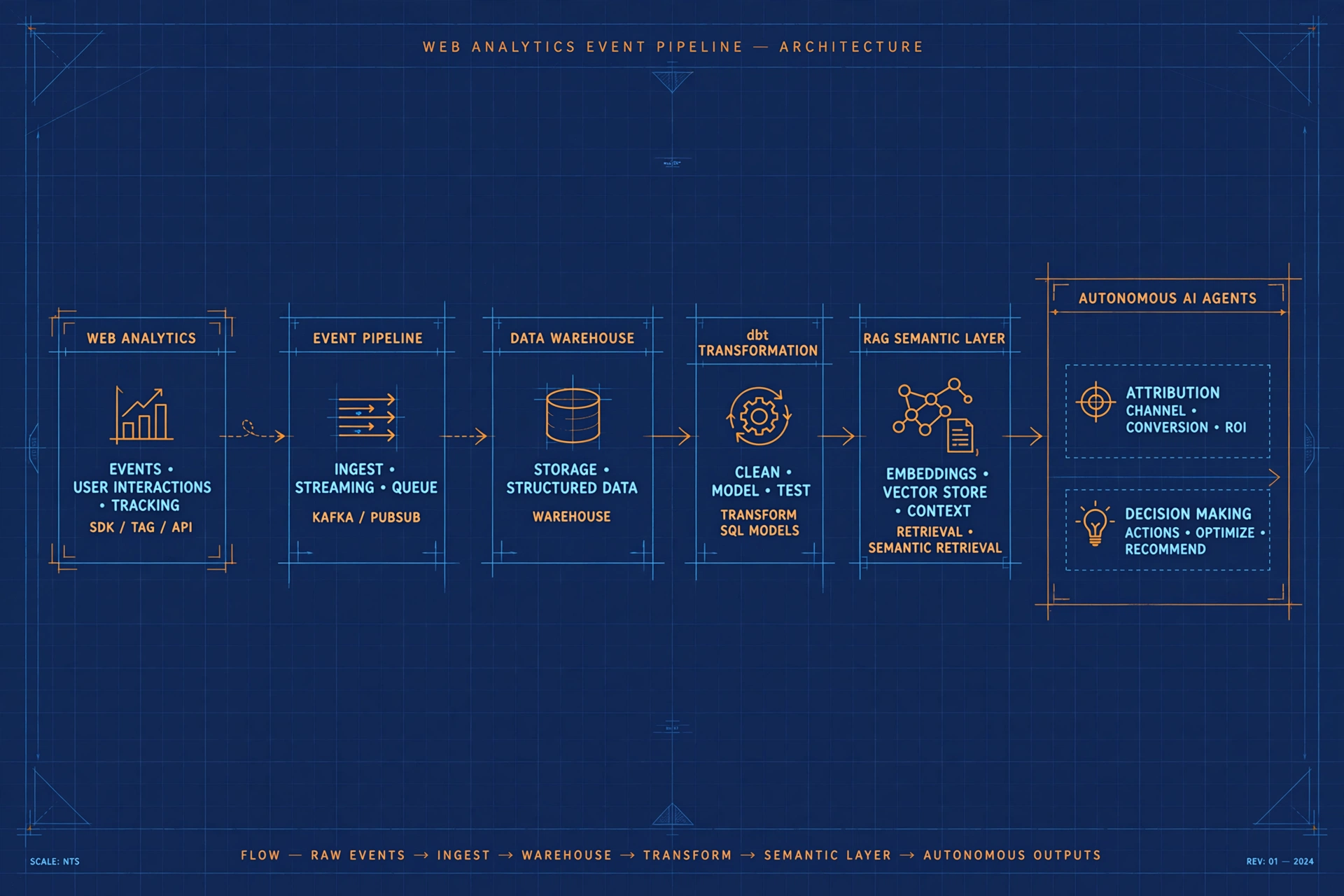
Forget the “10 analytics tools” table from 2020. Today the decision is architectural: a complete stack goes from event capture to the agent that acts. These are the 10 pieces we build on at BAOSS:
- Event ingestion (server-side): Snowplow, RudderStack, or Segment. First-party ID graph, consent enforcement, and schema registry. It is the foundation: if the data is bad on arrival, everything else fails.
- Product analytics: Amplitude or Mixpanel. Granular user behavior (funnels, retention, feature usage), ideal for complementing GA4’s channel view.
- Web/SEO analytics: GA4 + woorank/free alternatives. Traffic, acquisition, and page performance at a macro level.
- Warehouse: Snowflake, BigQuery, or MotherDuck (local dev). Compute/storage separation, time-travel, and zero-copy cloning.
- Transformation: dbt Core + dbt Cloud (CI/CD, contracts, tests). Versioning, lineage, and data contracts — the foundation for reliable RAG.
- BI / visualization: Looker Studio, Metabase, or Power BI. Fast readability for teams, connected to the warehouse with clean models.
- Semantic / RAG layer: LlamaIndex / LangChain + pgvector / Pinecone. Grounding: the agent queries versioned definitions, it does not hallucinate.
- Agent orchestration: LangGraph (complex), CrewAI (fast), AutoGen (multi-user). Coordination based on the complexity of the case.
- AI inference: vLLM + Ollama (local, sensitive data) or GPT-4o / Claude 4 (cloud, complex reasoning). P99 latency < 800 ms for real-time decisions.
- Agent observability: LangSmith / OpenTelemetry + Langfuse. Full traces of every decision: what it queried, what it reasoned, and what it acted on. Essential for auditing and improving.
Case 1: Fashion e-commerce — probabilistic attribution and automatic bid adjustment
Anonymized context: €8M/year, 60% paid traffic, 40% organic/direct. Team: 3 marketers, 0 data engineers.
Problem: iOS 17.4 + Consent Mode v2 = 41% of conversions without clear attribution. Meta reported a ROAS of 4.2x; the incremental reality (geo-lift) was 2.1x. Budget misallocated for 6 months.
BAOSS solution (8 weeks, 0 downtime):
- Weeks 1-2: server-side identity resolution (Snowplow + first-party ID graph). 94% coverage vs. 59% client-side.
- Weeks 3-4: RAG over dbt models: single definitions of “incremental conversion,” “LTV 90d,” and “real margin.” A validator agent prevents semantic drift.
- Weeks 5-6: multi-agent LangGraph system: Attribution Agent (lightweight Bayesian MMM, PyMC, updated daily), Budget Agent (integer linear optimization with cashflow constraints), and Guardrail Agent (detects anomalies > 3σ in CPA/ROAS and halts execution if confidence is < 85%).
- Weeks 7-8: MCP connects to Meta CAPI + Google Ads API + Slack (human-in-the-loop for budget changes > 15%).
Metrics 6 months post-go-live:
- Incremental ROAS: +23% (3.8x → 4.7x validated with geo holdout).
- Blended CAC: -37% (elimination of waste in “ghost” campaigns).
- Budget decision time: 4h → 12 min (87% of routine decisions automated).
- Project ROI: 4.1x in 6 months (the BAOSS fee was recouped in month 2).
Case 2: B2B SaaS — early churn detection and revenue expansion
Context: €3.2M ARR, 180 customers, sales-led + PLG model. 14%/year churn, NRR 98%.
Problem: the customer success team was reactive. Health scores based on login frequency had a correlation of only 0.23 with actual churn. Expansion opportunities were only detected at the QBR —too late—.
BAOSS solution (6 weeks):
- Data layer: product events (Amplitude) + CRM (HubSpot) + billing (Stripe) + support (Intercom) → Snowflake, with versioned dbt models.
- Semantic RAG: definitions of “churn risk,” “expansion signal,” and “champion user” in natural language, queryable by the agents.
- CrewAI agents (chosen for deployment simplicity): Signal Agent (scans 47 behavioral features and detects pre-churn patterns), Action Agent (generates a personalized playbook + meeting agenda + email to the sponsor), and Expansion Agent (identifies usage ceiling, opportunity to add seats, and budget signals).
- Human-in-the-loop: Slack + Linear. The CS approves or rejects; the feedback trains the preferences.
Metrics at 4 months:
- Churn: 14% → 9.2% (detection 34 days earlier than with the QBR).
- Expansion ARR: +18% (11 deals closed by the agent vs. 3 the previous quarter).
- CS team capacity: +40% of accounts per person (automated routine).
- NRR: 98% → 112%.
Why traditional analytics fails (and how we avoid it)
78% of AI initiatives on analytics never get past the pilot phase. The causes we see repeated:
- Thinking in terms of a single tool (“GA4 vs Adobe”) instead of a complete stack.
- No semantic layer: every team interprets “conversion” its own way; the agent does not know which definition to follow.
- AI without guardrails: a “creative” model over metrics that should be deterministic.
- No traceability: no one can audit what decision the system made and why.
Our methodology attacks these four points from the first week: a single definition of metrics (RAG over dbt), agents with roles and guardrails, human-in-the-loop for high-impact decisions, and complete observability (LangSmith + OpenTelemetry) to audit every decision.
Conclusion
The 10 tools matter, but the value lies in how they are orchestrated. In 2026, mature web analytics is an autonomous decision system on top of your real stack: clean events, a warehouse governed with dbt, a semantic layer that stops AI from hallucinating, and agents that turn signals into actions with selective human supervision.
At BAOSS we make it measurable from day one: KPIs defined before we build, ROI audited with clients, and stacks that work in production. If your analytics tells you “what” but no one decides “what to do next,” let’s talk.
Get your analytics diagnostic and find out how much value is in your data →