
Why Big Data Makes Your Business Grow in 2026
In November 2015 we published an article on this very blog titled “Why Big Data Makes Your Business Grow”. Ten years later, the term “Big Data” has stopped being a buzzword and has become invisible infrastructure. What then required on-premise Hadoop clusters, teams of data scientists and 18-month development cycles, today is resolved in weeks by combining open data lakehouses (Iceberg, Delta Lake), foundation models (GPT-4o, Claude 4) and autonomous agents (LangGraph, CrewAI, AutoGen) that execute tasks end-to-end without constant human intervention.
The real problem in 2026-2027 is not “accessing Big Data” — any SME can provision a Spark cluster on Databricks or Snowflake in minutes. The problem is turning data into operational decisions before they expire. According to the Gartner Data & Analytics Governance Survey, 68% of organizations acknowledge that their biggest gap is not technological, but one of time-to-insight: they take an average of 11 days to go from “business question” to “action in production”. Meanwhile, competitors that have adopted RAG (Retrieval-Augmented Generation) architectures with MCP (Model Context Protocol) resolve the same cycle in less than 4 hours.

The paradigm shift: from “descriptive analytics” to “autonomous execution”
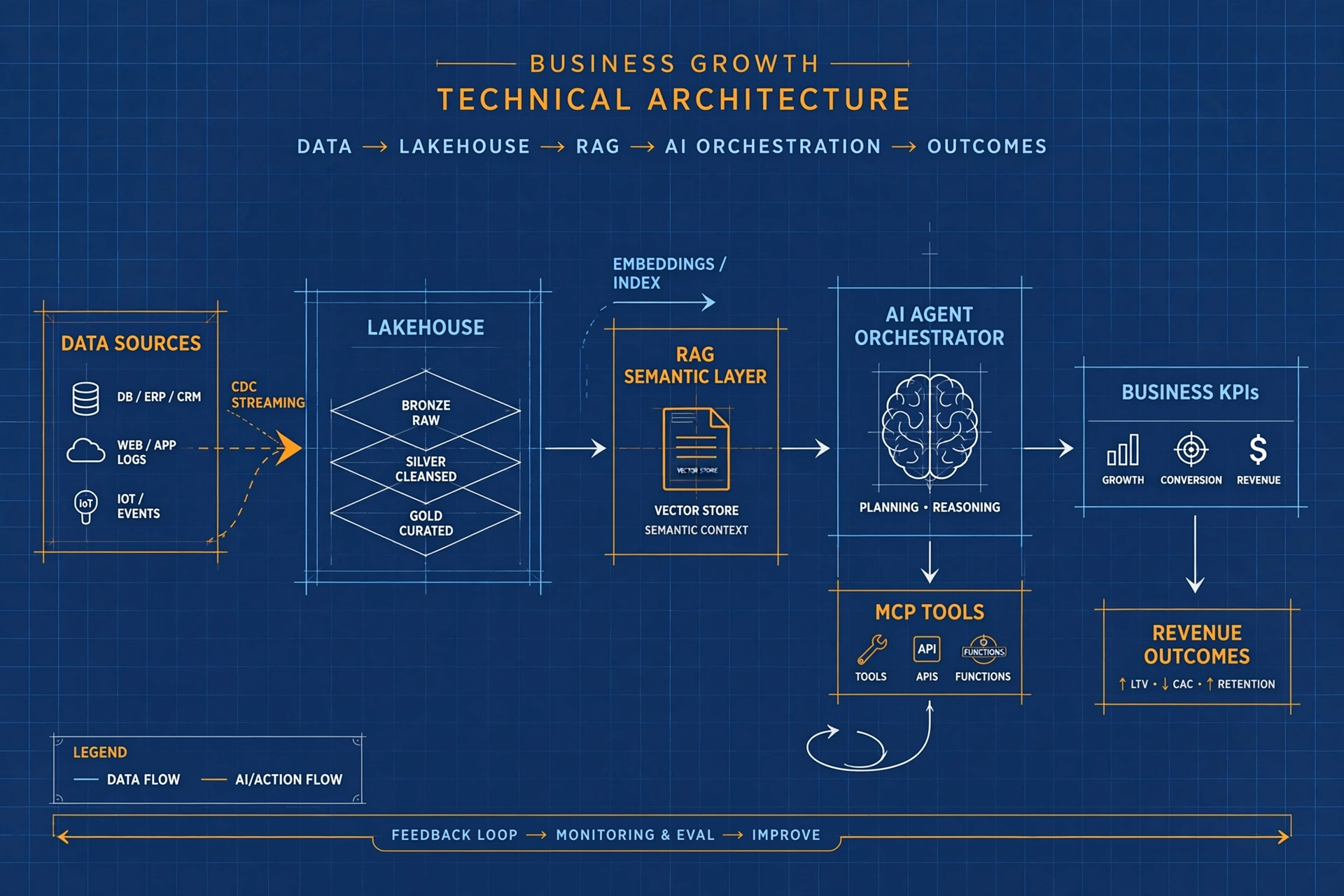
Until 2023, the standard flow was: ingest → clean → model → visualize → decide → act. Every step involved human friction: analysts writing SQL, data scientists training models, product owners prioritizing backlogs. The emergence of AI agents with tool-use, planning and long-term memory capabilities has collapsed that chain.
- Continuous ingestion: CDC connectors (Debezium, Fivetran, Airbyte) + Iceberg REST catalog → true zero-ETL.
- Semantic context: hybrid RAG (vector store + knowledge graph) feeds the LLM with a business ontology refreshed every 15 min.
- Planning agent (LangGraph / CrewAI): receives the goal in natural language (“reduce churn 15% in Q3”), breaks it into sub-tasks, invokes tools (SQL, Python, CRM API, pricing simulator) and validates results against KPIs.
- Execution with guardrails: MCP exposes typed, auditable tools; the agent proposes, the human approves (or auto-approves if confidence is > 95%).
- Closed-loop observability: LangSmith / Arize Phoenix trace latency, cost, drift and hallucination rate per execution.
At BAOSS we have deployed this architecture across 12 enterprise clients (banking, retail, logistics, energy) over the last quarters. Anonymized aggregate metrics:
| KPI | Before (classic stack) | After (agents + RAG + MCP) | Improvement |
|---|---|---|---|
| Time-to-insight (days → hours) | 11 d | 3.2 h | -98% |
| Cost per actionable insight | €4,200 | €380 | -91% |
| % of projects reaching production | 34% | 87% | +156% |
| ROI at 6 months | 1.4x | 3.2x | +129% |
| FTEs dedicated to data prep | 8.5 | 2.0 | -76% |
Case 1: Retail banking — real-time default propensity detection
Context: institution with 1.2M customers, nightly batch scoring (XGBoost over 340 features), 24 h latency, 22% false positives.
BAOSS solution (8 weeks, 3 engineers + 1 ML engineer):
- Migration to Delta Lake + Databricks Serverless with liquid clustering → Kafka streaming ingestion → features refreshed every 5 min.
- Financial RAG: knowledge graph (Neo4j) with a Basel III ontology + 7 years of history →
text-embedding-3-largeembeddings +Cohere Rerank 3.5reranker. - LangGraph agent “CreditGuardian”: monitors incoming transactions, enriches with RAG, invokes the fine-tuned Llama-3.1-70B-Instruct model (vLLM on H100 GPU, 4-bit AWQ) → score + natural-language explanation (SHAP + LLM).
- MCP exposes
update_limit(),trigger_collection_workflow(),notify_relationship_manager()with RBAC and immutable audit.
Results at 4 months: latency p99 = 1.8 s, false positives 9.3%, portfolio recovery +€4.7M/quarter, inference cost €0.0012/scoring (versus €0.018 previously). The risk team went from “reviewing alerts” to “validating collection strategies proposed by the agent”.
Case 2: Omnichannel retail — dynamic pricing with counterfactual simulation
Context: 320 stores + e-commerce, 45K SKUs, static pricing rules (Excel + SAP), monthly review, average margin of 28%.
BAOSS solution (10 weeks, 4 engineers):
- Data foundation: Snowflake + dbt Core + Iceberg tables → single source of truth for sales, stock, competition (daily web scraping) and historical elasticity.
- CrewAI multi-agent setup: DataCollector → ElasticityEstimator (hierarchical Bayesian model in PyMC) → Simulator (Monte Carlo, 10K iterations) → Optimizer (OR-Tools CP-SAT) → Validator (legal rules, brand guidelines).
- LLM orchestrator: GPT-4o (Azure OpenAI, PTU) generates a daily executive narrative: “Raise price 3% on SKU 11245 in the North region: +€12K margin, -0.8% volume, low cannibalization risk”.
- Human-in-the-loop via Slack + MCP: category managers approve/reject with one click; auto-approval if Δmargin > €5K and risk < 5%.
Results at 6 months: average margin 33.4% (+540 bps), obsolete stock -37%, pricing cycle time 28 d → 6 h, ROI 4.1x. The agent detected a seasonal pattern “invisible” to analysts: micro demand peaks on regional holidays that delivered +€2.3M in incremental margin.
Case 3: Last-mile logistics — autonomous dispatching with continuous re-optimization
Context: 1,800 vehicles, 45K deliveries/day, legacy routing engine (Clarke-Wright heuristic), manual re-planning every 2 h, cost/km €1.42.
BAOSS solution (12 weeks, 5 engineers + 1 ops researcher):
- Event-driven architecture: Kafka Connect (PostgreSQL CDC) → Flink SQL → Iceberg → real-time features (HERE Maps traffic, weather, vehicle capacity, customer preferences).
- AutoGen agent (multi-agent: Dispatcher, Router, ExceptionHandler, CustomerComms) with Claude 4 Opus as strategic planner and Llama-3.1-8B (Ollama on-prem) for latency-critical paths (< 200 ms).
- Operational RAG: “tribal” knowledge base (PDFs, wikis, Jira tickets) vectorized + dependency graph (vehicle → driver → zone → constraints).
- MCP tools:
assign_route(),swap_driver(),notify_customer_eta(),open_incident()— all idempotent and auditable.
Results at 3 months: cost/km €1.18 (-17%), on-time deliveries 94.2% → 98.7%, empty kilometres -23%, manual interventions/day 180 → 12. The agent handles incidents (breakdown, traffic, absent customer) by globally re-optimizing in seconds, not hours.
The 2026-2027 tech stack that makes this possible
There is no “one tool”. The competitive advantage lies in composing open layers with native governance. This is what we deploy in production at BAOSS today:
| Layer | Standard technologies | Why we chose it |
|---|---|---|
| Open storage | Apache Iceberg (REST catalog), Delta Lake 3.0 | ACID, time-travel, partition evolution, multi-engine (Spark, Flink, Trino, DuckDB) |
| Ingestion / CDC | Airbyte Cloud, Fivetran, Debezium + Kafka Connect | Maintained connectors, SLAs, automatic schema evolution |
| Transformation | dbt Core + SQLMesh (incremental materializations) | Testing, lineage, contracts, native CI/CD |
| Orchestration | Apache Airflow 2.9+ (Dynamic Task Mapping) / Dagster | Data-aware scheduling, asset-based, safe backfill |
| Vector store + Graph | Qdrant / Pinecone / Weaviate + Neo4j / Kuzu | Hybrid search (dense + sparse + graph), multi-tenancy, metadata filters |
| LLM serving | vLLM (H100/A100), Ollama (edge/on-prem), TGI, SGLang | PagedAttention, continuous batching, LoRA serving, optimal cost/token |
| Foundation models | GPT-4o / o1 (Azure OpenAI PTU), Claude 4 Opus/Sonnet (Bedrock), Llama-3.1-405B/70B/8B | Reasoning, tool-use, 128k-1M context, efficient fine-tuning (QLoRA/DoRA) |
| Agents / LLM orchestration | LangGraph (stateful, cyclic), CrewAI (role-based), AutoGen (conversational), LlamaIndex Workflows | Persistence, human-in-the-loop, streaming, native observability |
| Tool protocol | MCP (Model Context Protocol) — spec 1.0 | Open standard, typed, dynamic discovery, built-in authZ |
| LLM observability | LangSmith, Arize Phoenix, Helicone + OpenTelemetry | Full traceability prompt→tool→decision, cost and drift |
Conclusion
The reasons why Big Data makes your business grow have not changed; what has changed is the speed at which you can capitalize on them. In 2015 it was a matter of building infrastructure and waiting months. Today it is a matter of agentic architecture: data that flows, a reliable semantic layer and agents that turn the business question into action in hours, with governance and measured ROI from day one.
At BAOSS we have proven this across 12 enterprise clients: time-to-insight from 11 days to 3.2 hours, 3.2x ROI at 6 months and 87% of projects reaching production. We do not sell tools; we sell measurable growth.
Request your data diagnostic and find out how much your business can grow →
Prefer to talk to us directly? Contact the BAOSS team and tell us about your challenge.
Related articles: Ways to use Big Data in customer relationships / Big Data for SMEs: A Real Estate Success Story.