
Association Rules and Data Mining: from Apriori to Autonomous Discovery with AI
Association rules are a classic data mining technique with great value in retail, banking and logistics. For example, they discover that if a customer buys bread → they usually also buy butter (market basket analysis). The idea, formalized in the mid-90s with algorithms such as Apriori and FP-Growth, is still alive. In 2026, however, it is no longer run as a nightly script. Instead, it is now part of agentic architectures that discover patterns on streaming data. Thus, rules are deployed in real time. Below you will see how association rules, data mining and agents converge today into a single continuous discovery flow.
The goal of this article is twofold. First, to explain what association rules are and the metrics that make them reliable (support, confidence, lift). Then, to show how data mining has evolved in BAOSS’s practice. Specifically, toward autonomous discovery orchestrated by agents.
What are association rules? Key concepts
In association rule mining we start from a transaction base (shopping baskets, web sessions, claims). A rule takes the form {A} → {B} and is evaluated with three metrics:
- Support: how frequently the itemset {A,B} appears among all transactions. It filters out infrequent rules.
- Confidence: the conditional probability P(B|A) — of the transactions with A, how many include B?
- Lift: how much more likely B is when A is present than at random. Lift > 1 = real association; = 1 = independence. It is the most useful metric for discarding spurious correlations.
Classic algorithms: Apriori (generates frequent itemsets level by level with the antimonotonic property) and FP-Growth (compact tree without candidate generation). In Python, moreover, you have the mlxtend and pyfpgrowth implementations.
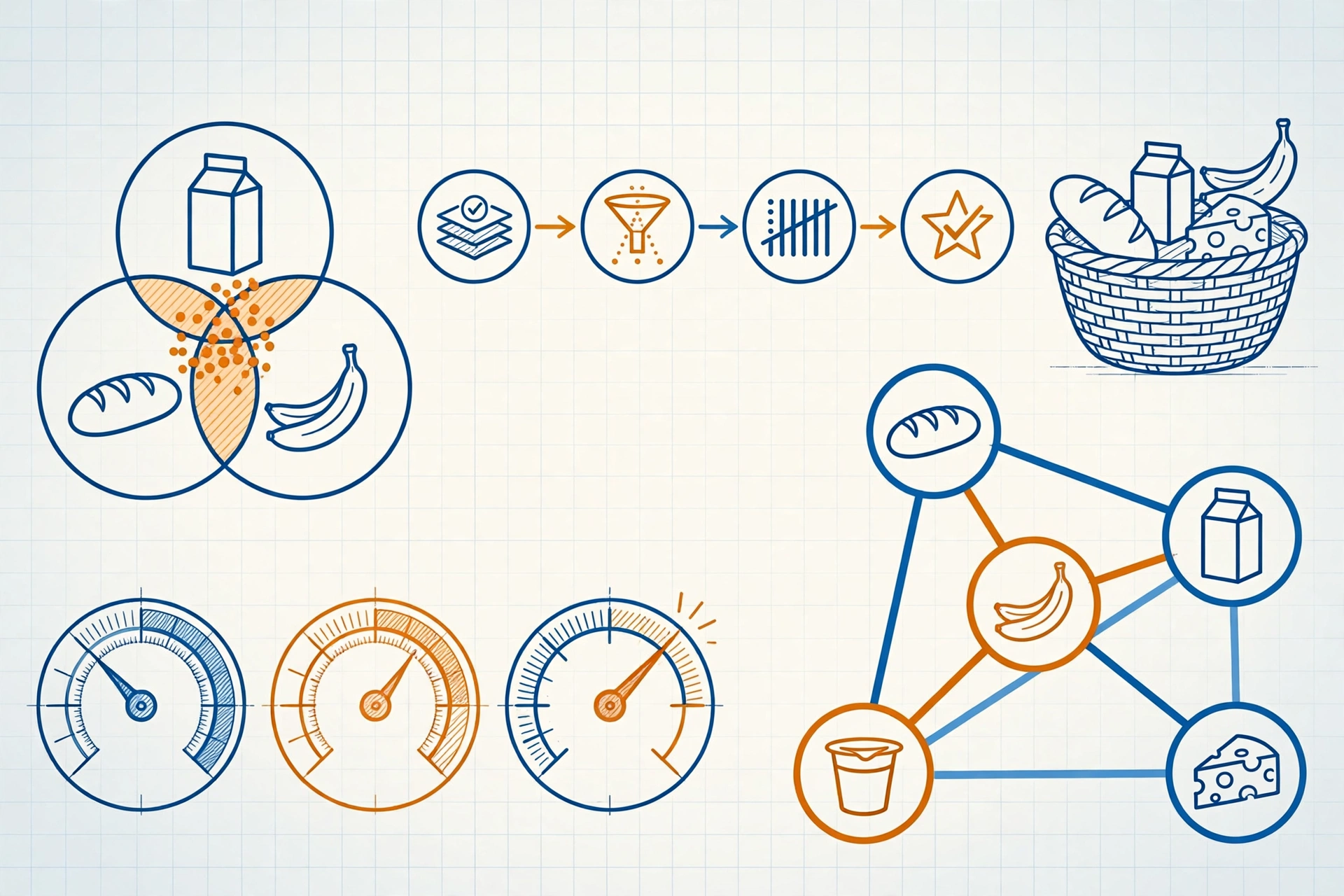
Association rules, data mining and agents: the real 2026 problem, from batch mining to continuous discovery
The classic rules (support, confidence, lift) remain mathematically valid, but they scale poorly in streaming environments with mutable schemas. A retailer with 12M transactions/day and a dynamic catalog (23%/month SKU rotation) cannot retrain Apriori every night. Nor can it maintain rules that expire due to concept drift.
According to Gartner, 78% of Spanish companies suffer from “analytical paralysis”: they have more data than ever (average growth of 42% year over year). Yet time-to-insight increases. The reason: teams spend much of their time cleaning and reconciling contradictory versions of the truth. The answer is not to abandon data mining. On the contrary, it is to orchestrate it with agents. Thus, patterns are discovered, validated and deployed in hours, not weeks. That paralysis is a symptom of disruption: AI agents, is your company exposed to the shock?

From KDD to Agentic Discovery: the 2026 tech stack
The KDD process (Knowledge Discovery in Databases) of 1996 covered selection, preprocessing, transformation, mining and evaluation. Today, that process has been compressed into autonomous feedback loops orchestrated by LangGraph, CrewAI or AutoGen. When those loops touch customer data, the risk of AI agents appears: without control, a discovered pattern can become a biased decision.
- Planner agent (GPT-4o / Claude 4 Opus): receives business goals in natural language. For example: “detect hidden cross-sell in the online channel”. It then breaks them down into subtasks.
- Researcher agent: queries vector stores (Qdrant, Pinecone) and knowledge graphs (Neo4j) to contextualize entities and products.
- Miner agent (Python + mlxtend/pyfpgrowth/River for streaming): runs the rule mining with Bayesian hyperparameter search (Optuna). It then validates statistical significance.
- The Validator agent (LLM-as-judge + causal inference): checks whether the rule produces real lift in a simulated A/B test. It also discards spurious correlations.
- Deployer agent (MCP + vLLM/Ollama): publishes the rules as feature flags in the feature store (Feast, Tecton). It then notifies stakeholders with SHAP/LIME explainability.
The result: discovery cycles go from 3-4 weeks to 4-6 hours, with human-in-the-loop only for the final strategic validation.
2026 tools: beyond RapidMiner and Weka
| Category | Legacy (2021) | 2026 standard | When to use it |
|---|---|---|---|
| Agent orchestration | — | LangGraph, CrewAI, AutoGen, Semantic Kernel | Multi-step pipelines with state and human-in-the-loop |
| Rule mining | RapidMiner, Weka | mlxtend, pyfpgrowth, River, creme, scikit-multiflow | Frequent itemsets, streaming and concept drift |
| RAG / Retrieval | — | LlamaIndex, Haystack 2.0, LangChain, GraphRAG | Business context over private data |
| Local inference | — | vLLM, Ollama, TGI, llama.cpp | Privacy, latency <100ms, controlled cost |
| Feature Store | — | Feast, Tecton, Hopsworks | Rules as features in downstream ML |
| Observability | Basic logs | LangSmith, Arize Phoenix, MLflow 3.0 | Full traceability agent → rule → decision |
Key note: Python remains the lingua franca (pandas 2.2+, Polars for out-of-core, DuckDB for embedded OLAP). However, the competitive edge lies in the orchestration layer, not in the mining algorithm per se.
BAOSS cases: real metrics, anonymized clients
Case 1: Retail — Next best action with streaming association rules
Challenge: 12M transactions/day, a catalog of 340 products, batch model with lift of 1.34x decaying due to concept drift.
Solution: Miner agent with River (streaming learning, 15-minute windows) + Feast feature store. The Validator agent runs daily counterfactual evaluation against a 5% holdout.
- Sustained lift of 2.87x (vs 1.34x batch) — +114% cross-sell conversion.
- Decision latency < 80 ms (p99), compatible with real-time bidding.
- 63% reduction in false positives thanks to the agent’s causal validation.
- ROI of 4.2x in 5 months.
Case 2: Last-mile logistics — hidden demand pattern with spatiotemporal rules
Challenge: 1,200 vehicles, 45,000 deliveries/day, 38% suboptimal routes due to unmodeled demand (local events, weather, flash sales).
Solution: The Miner agent applies sequential pattern mining (PrefixSpan adapted to streaming) to geolocation and event data. The rules are then injected into the OR-Tools optimizer as soft constraints with dynamic weights.
- 18.7% reduction in km per delivery — 2,840 tCO₂/year avoided.
- 34% improvement in the < 2h delivery SLA (92% → 98.3%).
- New rules deployed in 2.3h (vs 11 days manually).
- Payback in 3.1 months.
Case 3: Insurance — Fraud ring detection with graph-based association rules
Challenge: 2.8M policies, 145K claims/year. Organized fraud networks (staged accidents, clinic mills) invisible to univariate rules; estimated false negative rate of 31%.
Solution: A knowledge graph (Neo4j) with policyholders, vehicles, repair shops, clinics, adjusters and lawyers. The Miner agent applies association rule mining over graphs (AMIE+, AnyBURL). For example, it detects patterns such as “same lawyer + same clinic + 3+ claims in 60 days + workshops connected by shared ownership”. The Validator agent prioritizes by expected investigation value.
Results (8 months):
- Fraud networks identified in 1/3 of the previous time.
- False negative rate: 31% → 9%.
- Estimated savings from fraudulent payouts avoided: €2.3M/year.
- ROI of 3.8x (infrastructure + agents + reengineering of the investigation channel).
Conclusion: from the association rule to the deployed pattern
Association rules are not dead: they have been absorbed as just another skill within mining agents. The Apriori that used to run every night now coexists with streaming mining (River). It also coexists with lift validated by causal inference and with rules published as features in production. The classic technique provides the theoretical foundation; agentic orchestration provides the speed, the validation and the deployment. This agent layer over your data is the core of BAOSS, the operating system for business agents.
At BAOSS we design and implement that layer with metrics (lift, ROI, time-to-insight) and AI Act governance. That layer goes from the frequent itemset to the pattern deployed on streaming data.
Do you want to move from batch mining to real-time association rules with agents? Talk to our consulting team.
Prefer to talk to us directly? Contact the BAOSS team and tell us about your challenge.