
In the debate of Business Intelligence vs Data Analytics, the main difference lies in the time focus and the objective: Business Intelligence (BI) answers “what has happened and what is happening?” through reports and dashboards over historical data; data analytics goes further and seeks to understand “why it happened and what will happen”, applying statistics and predictive models. They do not compete: they are complementary stages of a company’s analytical maturity and of AI-driven productivity in your company.
What is Business Intelligence?
BI focuses on describing the business. It gathers data from different sources, consolidates it (usually in a data warehouse) and presents it in dashboards and reports. It answers questions such as: how much did we sell last quarter?, which region performs best?, how is a KPI evolving? Its value lies in providing a reliable, shared picture of the past and the present to monitor the business.
What is Data Analytics?
Data analytics covers a broader spectrum of techniques to explain and anticipate. It is usually classified into four levels:
- Descriptive: what happened (this overlaps with BI).
- Diagnostic: why it happened.
- Predictive: what is likely to happen (models and machine learning).
- Prescriptive: what we should do about it.
While BI looks mainly through the rear-view mirror, advanced analytics looks through the windshield.
Business Intelligence vs Data Analytics: how they differ
- Question: BI answers “what/when”; analytics adds “why/what will happen/what to do”.
- Data: BI works mostly with structured historical data; analytics incorporates diverse and real-time data.
- Users: BI is consumed by the business (executives, analysts); advanced analytics involves data scientists and engineers.
- Tools: BI uses dashboards (Power BI, Tableau, Looker); analytics uses modelling languages and platforms (Python, R, ML engines).
- Outcome: BI provides visibility; analytics provides prediction and recommendation.
Which one does your company need?
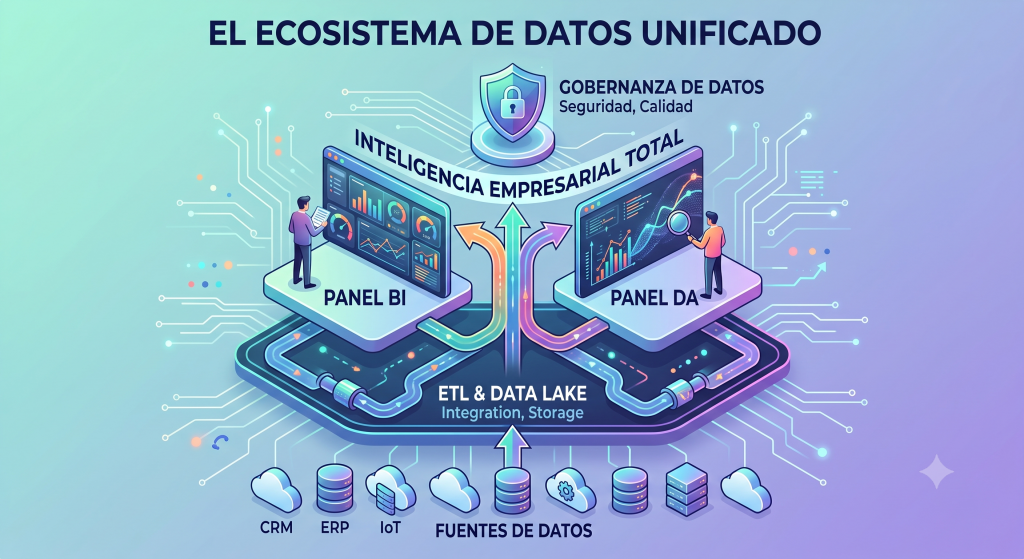
It is not “either one or the other”. The natural path is:
- Data foundations: integrate and clean the data (a solid data warehouse or lakehouse).
- BI first: reliable dashboards so the whole organisation decides with the same numbers.
- Advanced analytics afterwards: once the data is trustworthy, apply predictive and prescriptive models to the highest-value use cases.
Starting with advanced analytics without a solid data and BI foundation usually ends in frustration.
Frequently asked questions
Is BI part of data analytics? Yes; BI corresponds to descriptive analytics, the foundation on which advanced analytics is built.
Do I need data science to have BI? No. BI can be implemented with dashboard tools without requiring machine learning models.
Where do I start? By integrating and organising your data; without quality data, neither BI nor analytics deliver reliable results.
Ready to take the next step?
Want to move from reporting to prediction? At BAOSS, the operating system for business agents, we design your data, BI and advanced analytics architecture. Let’s talk.
Prefer to talk to us directly? Contact the BAOSS team and tell us about your challenge.