
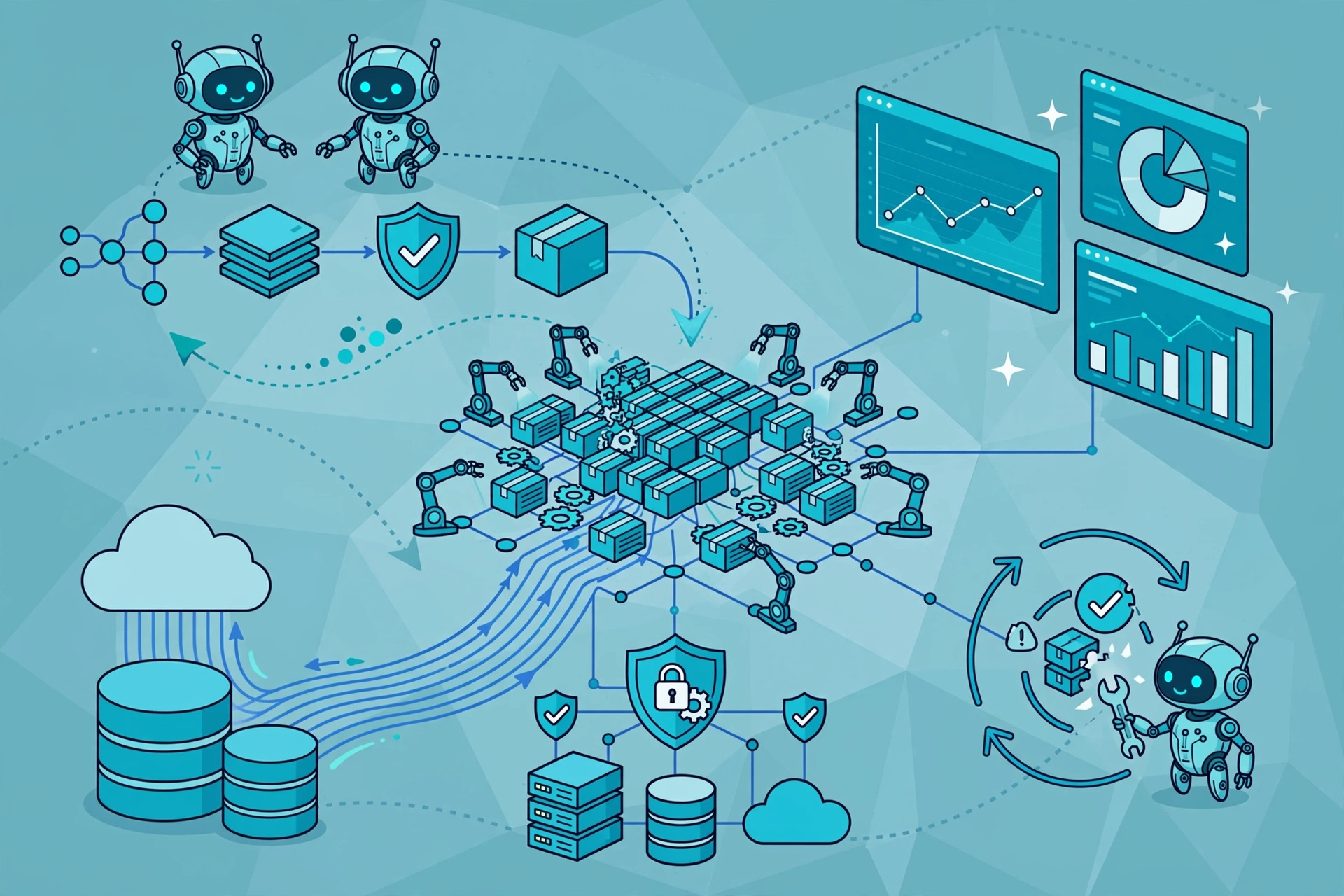
Automating Data Platforms 2026: from Apache Ambari to Autonomous Agents on Kubernetes
In 2014, Apache Ambari solved the headache of installing Hadoop clusters with a wizard and REST API. A decade later, the problem is no longer installing Hadoop. It is that Hadoop stopped being the standard. The 2026-2027 challenge is automating data platforms with k8s and autonomous agents. This way, we orchestrate hybrid data platforms: Kubernetes + open lakehouses (Iceberg, Delta, Hudi) + generative AI workloads + unified governance, all with a 99.9% availability SLA and small platform teams.
The real 2026-2027 problem: explosive complexity and talent gap
In fact, the data from the State of Data Engineering 2026 survey (Databricks + dbt Labs, n=3,200) paint a clear picture:
- Additionally, 78% of organizations run at least three different compute engines (Spark, Flink, Trino, DuckDB, vLLM).
- Likewise, 64% cite “operationalizing LLM models” as their biggest bottleneck, above data ingestion or data quality.
- Finally, the average time to put an end-to-end data product into production has risen to 4.3 months (versus 2.8 in 2023). This happens despite the proliferation of tools.
At BAOSS we see the same pattern in Iberian enterprise clients. These are platform teams of 4-6 people managing 15-20 multi-cloud Kubernetes clusters, each with its own custom observability, security and CI/CD stack. Therefore, the result: configuration drift, silent incidents and “shadow AI” deployed without governance.
Automate data platforms k8s agents: the 2026 automation stack
The analogy with Ambari remains useful: that is, we need a single control plane that installs, configures, monitors and auto-repairs. However, the implementation has changed radically:
| Layer | 2014 (Ambari) | 2026-2027 (BAOSS Reference Architecture) |
|---|---|---|
| Infra orchestration | Wizard + SSH | Cluster API (CAPI) + Crossplane + Terraform |
| Service packages | HDP/HDF stacks | Helm charts + Kubernetes Operators (Strimzi, Spark Operator, Ray Operator, vLLM Operator) |
| Declarative configuration | Ambari Blueprints | Kustomize + Argo CD + Kyverno (policies) |
| Observability | Ganglia + Nagios | OpenTelemetry + VictoriaMetrics + Grafana + Coroot (eBPF) |
| Autonomy / Auto-remediation | Alerts + manual runbooks | AI agents (LangGraph, CrewAI, AutoGen) + MCP + RAG over runbooks + metrics |
| Catalog / Governance | Apache Atlas (incubating) | OpenLineage + DataHub + Unity Catalog (OSS) + OPA/Gatekeeper |
Autonomous AI agents: the new “wizard” that never sleeps
In fact, the differentiating piece in 2026 is the autonomous agent layer. They are not chatbots. They are plan-act-observe-reflect loops that execute changes on the cluster via the Kubernetes API. To standardize tool access, additionally, there is MCP (Model Context Protocol). Let’s look at a real anonymized example:
BAOSS Case #1: Multi-cloud retail (anonymized)
Context: 12 EKS/GKE/AKS clusters, 400+ nodes, Spark Structured Streaming workloads + LLM inference (Llama-3.1-70B on vLLM) + federated Trino.
Problem: Configuration drift in spark.executor.memoryOverhead and vllm.gpu_memory_utilization after Helm upgrades; 3.2 incidents/month from costly silent OOMs.
Deployed solution:
- First, a LangGraph agent with Claude 4 Sonnet as reasoning LLM. It is connected via MCP to: Kubernetes API, Argo CD, VictoriaMetrics, DataHub and the runbook repository (Markdown + embeddings in Qdrant).
- Additionally, RAG over 1,200 historical runbooks + operator changelogs + Prometheus alerts.
- Finally, Kyverno policies that require a mutation webhook validated by the agent before applying any
HelmRelease.
Metrics at 6 months (real production):
- For example, 42% reduction in mean time to resolution (MTTR): 47 min → 27 min.
- Likewise, zero incidents from configuration drift in clusters governed by the agent.
- In short, ROI 3.4x (savings of 2.1 equivalent FTEs on call + reduction of SLA breaches).
- And finally, deployment of a new data product (ingestion → lakehouse → LLM API) in 11 days versus 38 days previously (−71%).
LLM inference at scale: vLLM + Ray + Kubernetes operators
Ambari managed stateless services (NameNode, ResourceManager). Today, however, the critical stateless service is inference of open models. The winning stack in 2026 is this:
- First, vLLM (PagedAttention, continuous batching, prefix caching) — 2.7x throughput vs. TGI on H100/A100.
- Additionally, Ray Serve / Ray Data for orchestrating RAG + inference + automatic evaluation pipelines (RAGAS).
- Likewise, KubeRay Operator + vLLM Operator for native K8s life cycle: autoscaling based on request queue, rolling updates without downtime, GPU fractioning with the NVIDIA GPU Operator.
- Finally, Ollama only on edge / dev. In production, however, vLLM + OpenAI-compatible API behind Kong/Envoy with rate-limiting, JWT and OpenTelemetry observability.
BAOSS Case #2: Banking — internal assistants platform (anonymized)
Challenge: 15 specialized assistants (risk, compliance, support, code) with RAG over 2.4 TB of private documentation. P95 latency < 800 ms, cost < €0.0015/1k tokens.
Architecture: 3 GKE clusters (dev/staging/prod) with L4 GPUs. Then, the vLLM Operator manages 7 models (Llama-3.1-8B, Qwen2.5-14B, Nemotron-3-Ultra). Additionally, LangGraph orchestrates router → retriever (hybrid BM25+dense) → reranker → generator → validator. Finally, MCP exposes tools: DataHub search, Trino query, triggering LoRA re-training in Ray Jobs.
Results at 4 months:
- First, actual cost: €0.0011/1k tokens (vs. €0.012/1k tokens GPT-4o API — 11x savings).
- Additionally, availability 99.94% (SLA 99.9%).
- Likewise, time from idea → production for a new assistant: 6 days (Argo CD template + validator agent).
- Finally, governance: 100% traceability of prompts/responses in DataHub + OpenLineage; automatic PII detection with Presidio in a sidecar.
Adoption patterns: where to start tomorrow
There is no need to rewrite the entire platform. So at BAOSS we recommend three incremental waves that deliver value in weeks:
Wave 1: GitOps + Policy-as-Code (weeks 1-4)
- First, migrate clusters to Argo CD + App of Apps.
- Then, implement Kyverno for: mandatory labels, resource quotas, banning
privileged: true, validating signed images (cosign/sigstore). - Additionally, centralize secrets in External Secrets Operator + Vault/Secrets Manager.
- Finally, target metric: configuration drift < 2% (measured with nightly
argocd app diff).
Wave 2: Unified observability + basic auto-remediation (weeks 5-10)
- First, deploy the OpenTelemetry Collector (DaemonSet + Deployment) → VictoriaMetrics + Loki + Tempo.
- Then, standardized dashboards (Grafana) per workload type: Spark, Trino, vLLM, Ray, Kafka, Iceberg compaction.
- Additionally, multi-dimensional alerting rules (symptom + impact + runbook URL) — not static thresholds.
- Likewise, first LangGraph + GPT-4o mini agent (low cost). Its flow: receives alert → queries RAG runbooks → proposes
kubectl patch/argo rollout retry→ human approves in Slack/Teams. - Finally, target metric: MTTR < 30 min for P1/P2 alerts.
Wave 3: Full autonomous agents + AI Platform (weeks 11-24)
- First, extend the agent to Claude 4 / GPT-4o with full MCP (K8s, Argo, DataHub, Git, Jira, Confluence).
- Then, enable auto-merge for low-risk changes (resource limits, replicas, configmaps) after validation in staging.
- Additionally, deploy vLLM Operator + KubeRay for LLM workloads; migrate from external APIs to open models (Llama, Qwen, Nemotron, Mixtral).
- Likewise, implement continuous evaluation (RAGAS, DeepEval) as an Argo Rollouts step before promoting to prod.
- Finally, target metric: Lead time for changes < 1 day (DORA elite) for data products; inference cost < 30% of total cloud spend.
Common mistakes in 2026 (and how to avoid them)
- Adopting Kubernetes without GitOps → drift and heterogeneous configurations. Solution: Argo CD + App of Apps from day 1.
- Then, treating LLM models as “black boxes” without evaluation or governance → hallucinations and shadow AI. Solution: RAGAS/DeepEval in CI + DataHub + OpenLineage.
- Additionally, poorly sized GPUs → cost explosion. Solution: vLLM + NVIDIA fractioning + autoscaling by request queue.
- Likewise, automating without human-in-the-loop → risky changes without validation. Solution: agents propose, humans approve for destructive changes.
- Finally, ignoring the semantic layer → agents without context. Solution: catalog + data contracts + versioned embeddings.
Conclusion: from Ambari to the autonomous control plane
In short, Ambari taught us the value of a single control plane. In 2026-2027, that plane is no longer a wizard: it is a layer of autonomous agents on top of GitOps, observability and AI that installs, configures, monitors and auto-repairs the data platform with full traceability.
Additionally, at BAOSS we help you automate data platforms with k8s and agents and implement that control plane: multi-cloud Kubernetes, open lakehouse, agents with MCP and unified governance, with metrics (MTTR, lead time, inference cost) and audited ROI.
Want to stop firefighting on your data platform and move to governed autonomous agents? Talk to our consulting team.
Prefer to talk to us directly? Contact the BAOSS team and tell us about your challenge.