

In October 2020 we published our first analysis of Insurtech, when the Spanish insurance sector was barely reaching 12% digitalization across core processes. Four years later, the landscape has changed radically: 67% of Spanish insurers now have generative AI pilots in production (Mapfre Economics, 2024), yet only 23% manage to scale them beyond the PoC stage. The problem is no longer “digitalizing” but rather operationalizing AI with governance, traceability and measurable ROI.

The 2026-2027 bottleneck: fragmented data, DORA regulation and scarce talent
Medium-sized insurers (€500M-€5B in premiums) share three real pain points that we have validated across 14 BAOSS projects over the past year:
- Claims: 68% of time is consumed by administrative tasks (classification, extracting data from PDFs, communicating with adjusters), not decision-making. The combined ratio suffers by 3-5 points.
- Underwriting: 40% of complex policies require manual review due to a lack of unified historical context. Time-to-quote: 14 days versus a 4-hour target.
- DORA/NIS2 compliance: 0% end-to-end visibility of critical technology dependencies. Potential fines: 2% of annual turnover.
The difference from 2020: it is no longer a matter of missing tools (GPT-4o, Claude 4, vLLM, Ollama), what is missing are architectures that make them reliable in production. A naive RAG hallucinates clauses; agents without MCP (Model Context Protocol) cannot reach the core systems; and fine-tuning without continuous evaluation degrades within weeks.
BAOSS 2026 reference architecture: autonomous agents + hybrid RAG + MCP
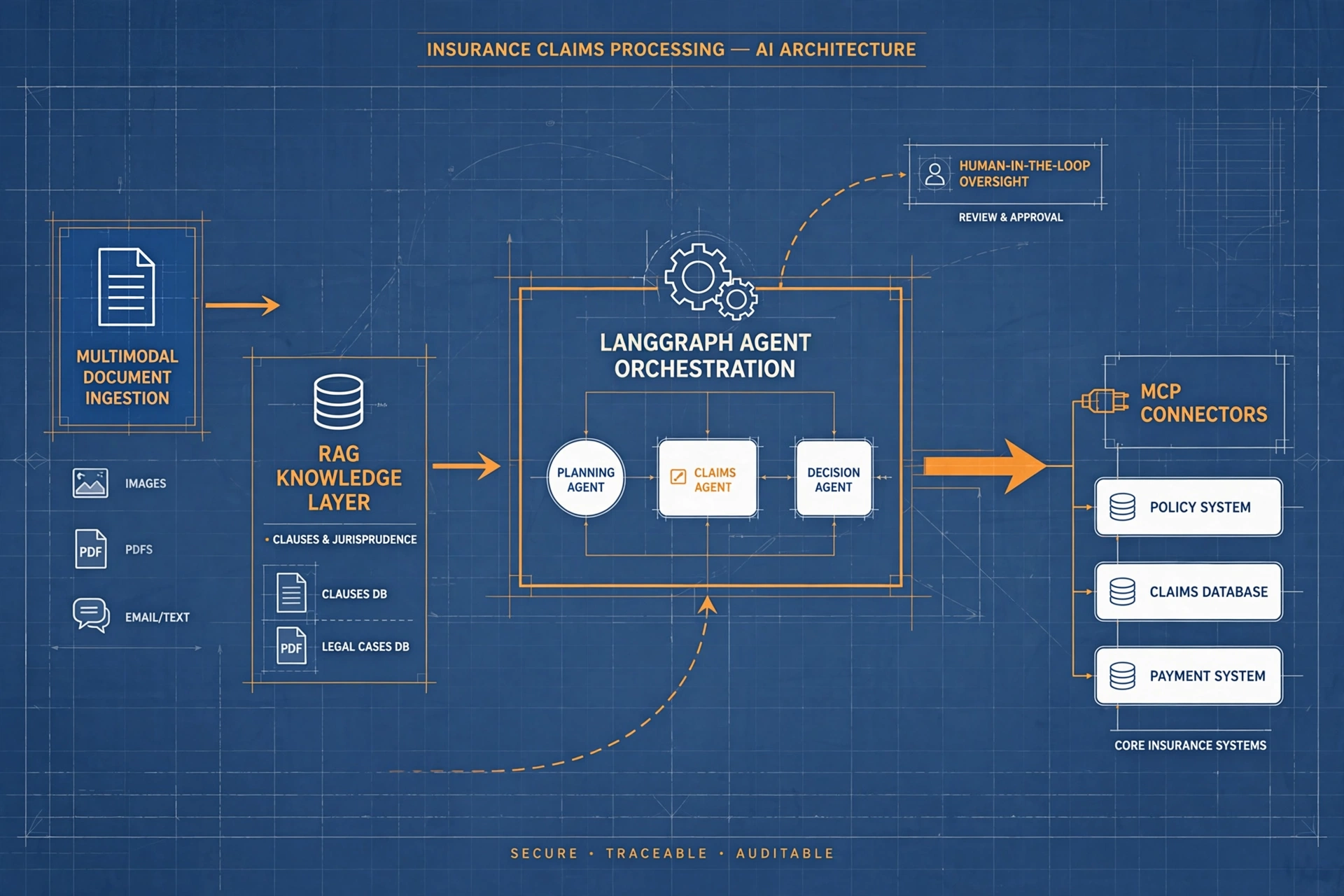
Our current stack for Insurtech combines three layers that resolve the typical failures:
- Knowledge layer (hybrid RAG): Vector DB (Qdrant/Weaviate) + Graph RAG (Neo4j) for clauses, case law and claims history. Semantic chunking + reranking (Cohere Rerank 3.5) + exact citation to the PDF page. Reduces hallucinations to under 0.8%.
- Reasoning layer (LangGraph/CrewAI agents): deterministic flows with human-in-the-loop at critical decision points. Each agent exposes MCP servers to connect with Guidewire, Sapiens, Duck Creek or the legacy mainframe via an API gateway.
- Observability layer (LangSmith + OpenTelemetry): full prompt→tool→response traceability. Automated nightly evaluation (RAGAS + custom metrics: hallucination rate, citation accuracy, p95 latency).
Why not just GPT-4o? Because a single LLM does not know your business. It needs structured context (RAG), the ability to act (tools/MCP) and correction loops (multi-step agents with reflection). We have measured it: RAG alone = 62% accuracy on complex clauses; RAG + reflective agent = 91%.
Anonymized real case: Top-10 Spanish Life/Savings insurer — automating death claims
Context: 12,000 claims/year, average 45-day cycle, 8 FTEs dedicated solely to classifying documentation (death certificates, last will and testaments, policies, ID documents).
Deployed solution (12 weeks, 3 sprints)
- Multimodal ingestion: Unstructured.io + OCR (Tesseract + LayoutLMv3) → normalization to canonical JSON.
- Classifier agent (LangGraph): 5 specialized nodes (document validator, beneficiary extractor, coverage verifier, reserve calculator, communication generator). Each node = versioned prompt + curated few-shots + MCP tool to the core.
- Selective human-in-the-loop: only escalates to a manager if confidence < 0.92 or amount > €150k. 78% of cases are resolved without human touch.
- Continuous evaluation: golden dataset of 500 cases. Weekly metrics in LangSmith. Automatic rollback if F1 < 0.88.
Results at 6 months (real production, not a PoC)
- Average cycle: 45 → 11 days (-76%).
- FTEs freed up: 6.2 → reassigned to complex claims handling and care for vulnerable customers.
- Combined ratio in life claims: -2.3 points.
- ROI: 3.8x in 8 months (total project cost: €340k versus €1.3M/year in recurring savings).
- DORA compliance: 100% decision→data→model traceability.
Technical key: we do not do fine-tuning. We use hybrid RAG + structured prompting + continuous evaluation. Lower cost, more control, and auditable by the regulator.
Anonymized real case: SME broker — multi-line commercial underwriting in hours, not weeks
Context: 3,500 policies/year across new business and renewals. Questionnaires of 40+ questions, data scattered across CRM, emails and insurer portals. Time-to-bind of 14 days. 22% of opportunities lost due to slowness.
Agent architecture (CrewAI + MCP + local vLLM)
- “Risk Profiler” agent: connects via MCP to CIRBE, INE, Catastro, commercial registries and its own loss history. Generates a structured risk profile in 90 seconds.
- “Policy Matcher” agent: RAG over 1,200 products from 12 insurers (clauses, exclusions, appetite). Recommends the 3 optimal ones with traceable justification.
- “Document Generator” agent: fills in questionnaires, generates DIP, IPID and contracts. Validates cross-coherence (sums insured vs. risk value).
- Human review: the broker validates the final recommendation. The agent learns from corrections (preference learning via DSPy).
Metrics at 4 months post-go-live
- Time-to-quote: 14 days → 3.2 hours (-98%).
- Conversion rate: 68% → 84% (+16 points).
- Underwriting errors (post-bind endorsements): -63%.
- Infrastructure cost: €0.12/policy (vLLM on own GPU, zero token cost).
- Broker satisfaction (NPS): +31 points.
Strategic decision: local models (Llama-3.1-70B-Instruct via vLLM/Ollama) for sensitive data. Zero data egress, p95 latency of 1.8s and DORA compliance by design.
The 2026 Insurtech ecosystem: from comparison sites to “insurance-as-a-service AI”
The players we cited in 2020 (Rastreator, Wefox, Coverfy, Klinc) have pivoted or consolidated. The new 2026-2027 wave is not marketplaces but specialized AI platforms:
- Shift Technology / Tractable / ControlExpert: computer vision + LLM for auto/home claims assessment. They process 40M+ claims/year globally.
- Zelros / Akur8 / Earnix: native AI pricing & underwriting, integrated via API into core systems.
- Neos / Wrisk / Laka: full-stack digital MGAs with AI embedded in the product (pay-per-use, behavioral).
- AI-first vertical Insurtechs: Cytora (commercial), Planck (data), Atidot (life), Digital Fineprint (SME).
In Spain, Mapfre Insur_space, Wayra (Telefónica) and Startupbootcamp Insurtech are accelerating startups with real traction (ARR > €500k), not just slides. Corporation-startup collaboration has matured: paid PoC in 8 weeks → framework contract if KPIs are met.
Technical checklist for your 2026 roadmap (validated across 14 deployments)
- [ ] Data inventory + quality: do you have a unified catalog of clauses, claims and policies? Documented lineage? (Prerequisite for a reliable RAG.)
- [ ] Use cases prioritized by ROI, not hype: high-frequency/low-complexity claims > complex underwriting > customer service.
- [ ] MCP-first architecture: expose the core systems as MCP servers. Avoid spaghetti of ad-hoc connectors.
- [ ] Evaluation before model: define the golden dataset, business metrics (not just accuracy) and CI/CD for prompts.
- [ ] AI governance from day 1: model registry, risk assessment (EU AI Act), human oversight and rollback plan.
- [ ] Hybrid talent: you need AI Engineers (not just data scientists) who master LangGraph, RAG, evals and GPU infrastructure.
- [ ] Measurable quick win < 12 weeks: a document classifier, clause extractor or coverage recommender. Demonstrate value and buy license.
Mistakes that still kill Insurtech AI projects (and how we avoid them)
- “We bought Copilot/ChatGPT Enterprise and that’s it” → without its own RAG, it hallucinates clauses. Solution: hybrid RAG + continuous evaluation.
- “We fine-tune Llama with our PDFs” → catastrophic: it forgets the base knowledge, it is expensive and opaque. Solution: RAG + prompting + few-shots. Only fine-tune if you have > 100k curated examples and the evals prove a gain of > 5 points.
- “Autonomous agents without brakes” → regulatory and reputational risk. Solution: LangGraph with interrupt nodes + policy engine (OPA) + immutable auditing.
- “Data in the public cloud without sovereignty” → DORA/NIS2 prohibit it for critical systems. Solution: vLLM/Ollama on-prem or hybrid + sovereign GPU (AWS EU Sovereign, Azure EU, local providers).
- “An IT project, not a business one” → without loss-ratio, conversion or cost KPIs. Solution: business/IT co-ownership from kickoff, with shared OKRs.
Next 18 months: trends we are already implementing
- Multi-organization agents (A2A): broker ↔ insurer ↔ reinsurer ↔ adjuster exchanging context via standardized MCP. The Agent-to-Agent protocol is emerging and will be the next standard.
- Data sovereignty as a competitive advantage: insurers that keep their models and data on sovereign infrastructure will win the trust of both regulator and customer.
- From automation to self-learning: agents will move from executing rules to refining their own policies with continuous evaluation and preference learning, always under human supervision.
Conclusion
The technological evolution of the insurance world is no longer a matter of choosing between one comparison site and another. It is a fundamental transformation: from processing documents to processing decisions, with reliable, traceable and well-governed AI agents. The sector that masters the reasoning layer — not the one with the most tools — will win margin, trust and market share.
At BAOSS we have 14 Insurtech deployments in production with audited metrics: claims from 45 to 11 days, underwriting from 14 days to 3.2 hours, and DORA compliance by design. We do not sell tools; we sell architectures that work.
Request your AI diagnostic for insurers and discover the real ROI of your digitalization →