
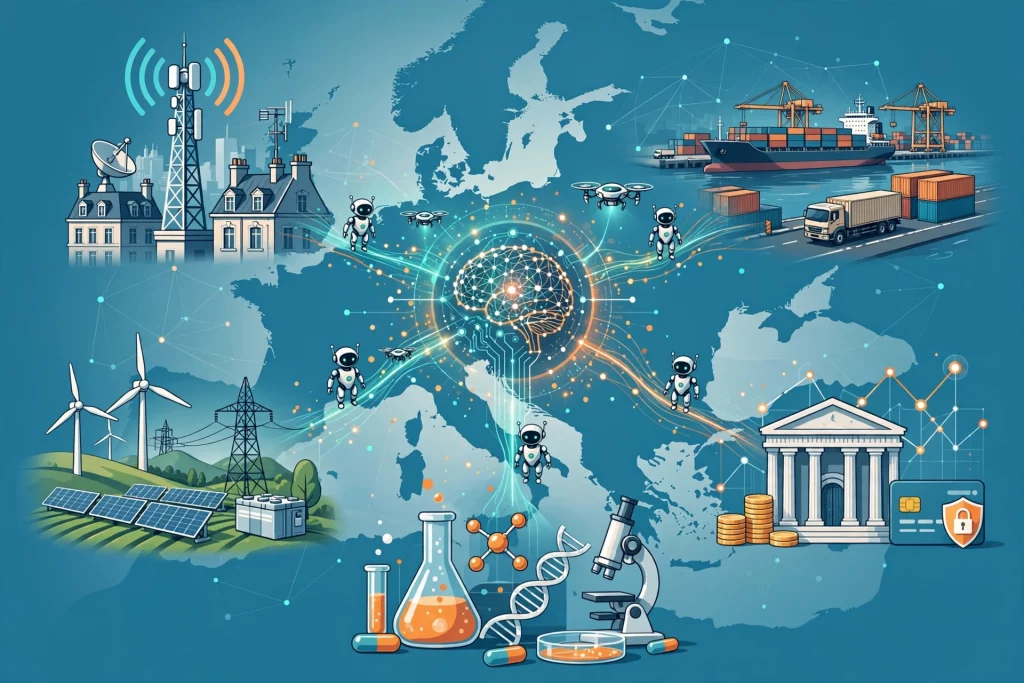
Back in 2017 we published this same article listing “10 Big Data examples.” Eight years on, the question is no longer what can be done with data, but how fast you can move from data to an operating decision. At BAOSS we have accompanied more than 40 organisations in 2025-2026 to close that gap. The pattern repeats: fragmented data, models trapped in notebooks that never reach production, and overwhelmed data teams asking for “more engineers” when what they actually need is agent architecture and governance from day one.
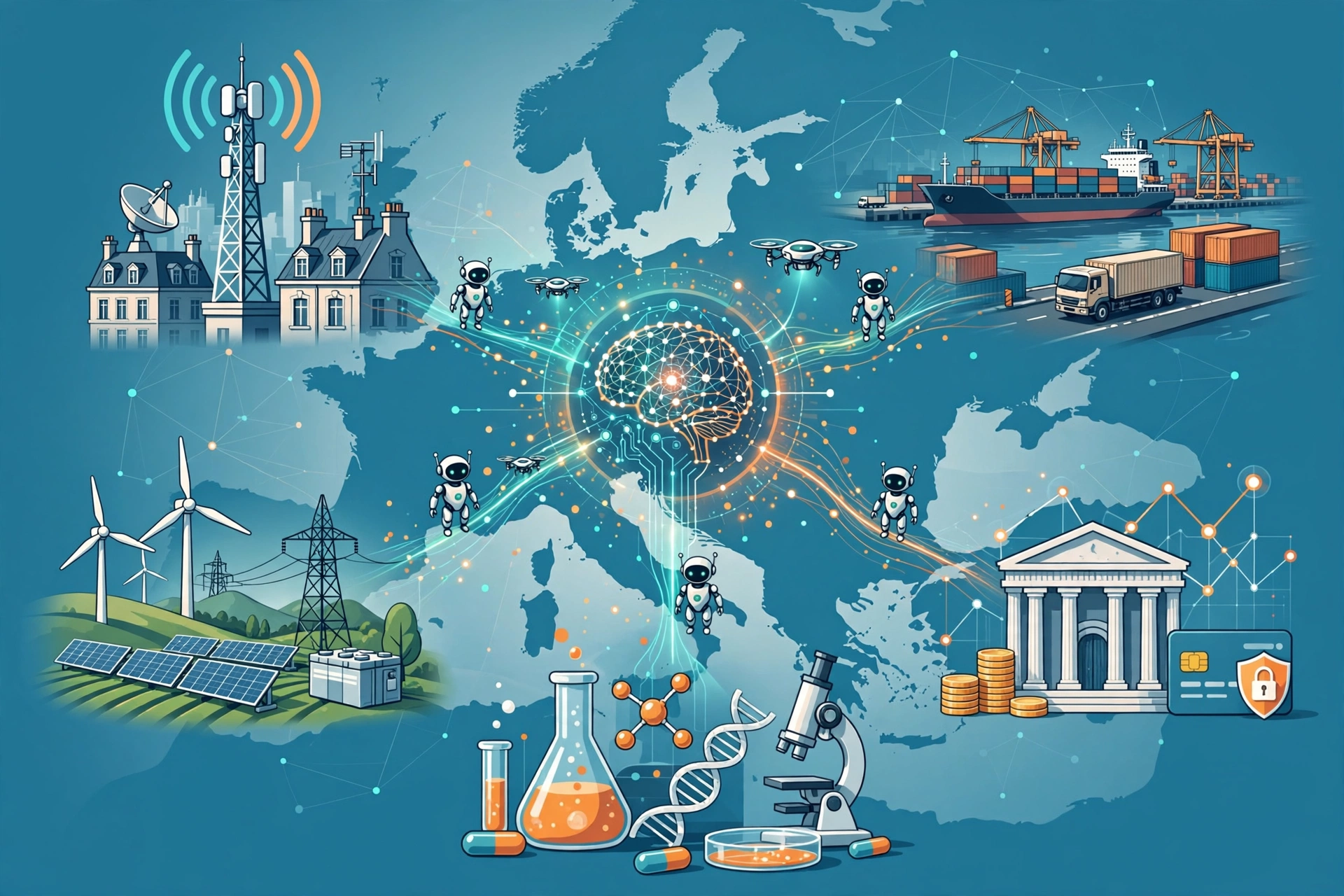
The 2026 paradigm shift: from “Data Lake” to “Data Product”
Companies that scale analytics in 2026 share three traits: they treat every dataset as a product with an SLA and an owner, they deploy models with native CI/CD for ML (MLOps level 2+), and they use autonomous agents (LangGraph, CrewAI, AutoGen) to orchestrate ingestion, validation, feature engineering and explainability tasks without constant human intervention. The “modern” stack is no longer Spark + Airflow + Superset; it is Iceberg/Delta Lake + dbt + vLLM/Ollama (local LLMs) + MCP (Model Context Protocol) + RAG evaluated with RAGAS.
What is the average result for our clients? A 6-8 week time-to-value versus the 9-12 months of the classic “build a data lake first and then see” approach. Below, five real problems we solved in 2025-2026 (names and sectors anonymised, metrics audited).
Case 1: Telco — predictive churn + hyper-personalisation with GenAI
The problem: a mobile operator (12M lines) was losing 1.8% of its high-value customers every month. Its batch XGBoost model (trained monthly) detected risk with 72% recall, but retention campaigns took 3 weeks to activate and used static templates.
The BAOSS solution: we migrated to a centralised feature store (Feast + Iceberg) with hourly refresh. We deployed a LangGraph agent that: (1) monitors feature drift in real time, (2) retrains automatically if AUC drops > 2pp, (3) generates 1:1 offers with structured GPT-4o (JSON Schema) conditioned on history, current plan, data usage and call-centre sentiment (transcribed with Whisper v3). The offer travels via API to the CRM in under 5 minutes.
- Churn recall: 72% → 89% (3-month holdout validation).
- Data→offer time: 21 days → 4 minutes.
- Retained ARPU: +14% versus the control group.
- LLM inference cost: €0.0018/offer (vLLM on a shared A100 GPU, dynamic batching).
Key lesson: the predictive model is a commodity; the differentiator is the closed data→decision→feedback loop with prompt governance (versioning, automatic evaluation with PromptFoo and PII guardrails).
Case 2: Logistics/retail — last-mile optimisation with multi-objective agents
The problem: a fleet of 3,200 vehicles and 1.1M deliveries/month. The classic optimiser (OR-Tools, 4-hour window) could not absorb incidents in real time (traffic, breakdowns, demand spikes). Cost/km was 18% above the benchmark and 22% of deliveries missed their committed time slot.
The BAOSS solution: a CrewAI architecture with 4 specialised agents: Demand Forecaster (LightGBM + exogenous features: weather, events, macro), Route Planner (HGS-CVRP re-optimising every 15 minutes), Exception Handler (rewrites routes only for the affected vehicles), and Driver Communicator (generates voice/text instructions with Claude 4 Sonnet, prioritising safety and SLA). All running on Kafka + Flink SQL for telemetry streaming (1.2M events/min).
- Cost/km: -16% (saving €2.3M/year).
- On-time deliveries: 78% → 94%.
- Re-optimisations/day: 0 → 3,400 (autonomous, no operator).
- P99 latency event→new route: 8 seconds.
Key lesson: agents do not replace the mathematical optimiser; they surround it to make it reactive, explainable and tolerant of dirty data. MCP exposes the solver as an invocable tool with a versioned schema.
Case 3: Banking — fraud detection + regulatory explainability (RAG + MCP)
The problem: a mid-size institution (4M clients, 85M tx/month). The rules + XGBoost engine generated 12,000 alerts/day; the investigation team (18 analysts) cleared 1,100. A 94% false-positive rate. On top of that, the EBA Guidelines require full traceability of the why behind every blocked transaction.
The BAOSS solution: a dual pipeline: (1) streaming scoring (Flink + ONNX Runtime, 12 ms/tx) with behavioural features (tx-sequence embeddings via TabTransformer); (2) explanatory RAG for each alert: it retrieves the internal policy, the client’s history and the EBA case law, and generates a natural-language report with GPT-4o (strict mode, temperature 0) validated by Guardrails AI. The analyst sees: score, top-5 SHAP features and a narrative ready for the case file. Deployment with MLflow + Kubernetes (Argo Rollouts), 5% canary.
- False positives: 94% → 67% (same detection rate).
- Investigable alerts/day/analyst: 61 → 140 (+130%).
- Report time: 18 min → 45 sec (automatic generation + review).
- Audit: 100% of alerts with complete traceability (prompt, retrieved context, model version).
Key lesson: RAG is not “chat with PDFs.” In production it requires continuous evaluation (RAGAS: faithfulness > 0.92, answer_relevancy > 0.89), domain-specific semantic chunking, and MCP so the agent can invoke tools (DB queries, risk calculator) without hallucinating.
Case 4: Pharma — clinical-trial optimisation with synthetic digital twins
The problem: an oncology phase III, 600 patients, 18 countries. Recruitment running 40% below plan; cost of each day of delay: €380k. Historical data fragmented across 14 CROs with heterogeneous formats (EDC, ePRO, wearables, genomics).
The BAOSS solution: a federated data mesh (data contracts with OpenLineage, quality with Great Expectations in CI). We trained a survival model (DeepSurv) to predict dropout and response. Innovation: conditioned synthetic patients (CTGAN + tabular diffusion), validated by an ethics committee, to simulate control arms and cut the sample size by 15%. An AutoGen agent monitors recruitment KPIs per day per site and suggests actions (change inclusion criteria, activate a backup site, adjust visits).
- Recruitment time: -22% (4.2 months gained).
- Direct savings: €48M (cost per day × days saved + sample reduction).
- Data quality: 98.7% completeness versus the previous 91% (contracts + automatic validation).
- Updated probability of success (POS): +9pp after simulating 10k scenarios.
Key lesson: synthetic data does not replace real patients, but when properly governed (differential privacy ε=0.5, multivariate statistical validation) it accelerates trial-design decisions. The AutoGen agent acts as a “clinical operations copilot,” not a black box.
Case 5: Energy — hybrid predictive maintenance (physics + ML) in wind farms
The problem: 14 wind farms, 420 turbines (2.1 GW). The vibration model (Random Forest) generated 34 alerts/week; 78% were false. Unplanned shutdowns: 12/year × 4.5 days average = 54 days/year lost (≈€18M).
The BAOSS solution: a lightweight digital twin per turbine (physics equations + parameters calibrated against 10 Hz SCADA history). The physics→ML residual (a multivariate Transformer) detects deviations that physics alone cannot explain. A CrewAI agent prioritises alerts by cross-referencing: asset criticality, weather window (helicopter/boat access), spare-parts stock and the electricity pool price. It generates the work order in Maximo with parts kit, procedure and safety risk.
- False alarms: 78% → 22%.
- Unplanned shutdowns: 12 → 3/year (-75%).
- Availability: 96.2% → 98.7% (+2.5pp = +€14M/year in revenue).
- Model cost: €0.04/turbine/day (CPU inference, nightly batch).
Key lesson: the physics-ML hybrid beats “data only” when the physics is known and failures are rare. The agent turns the prediction into an executable action plan by integrating real operational constraints.
2017 vs 2026 stack: what died and what scales
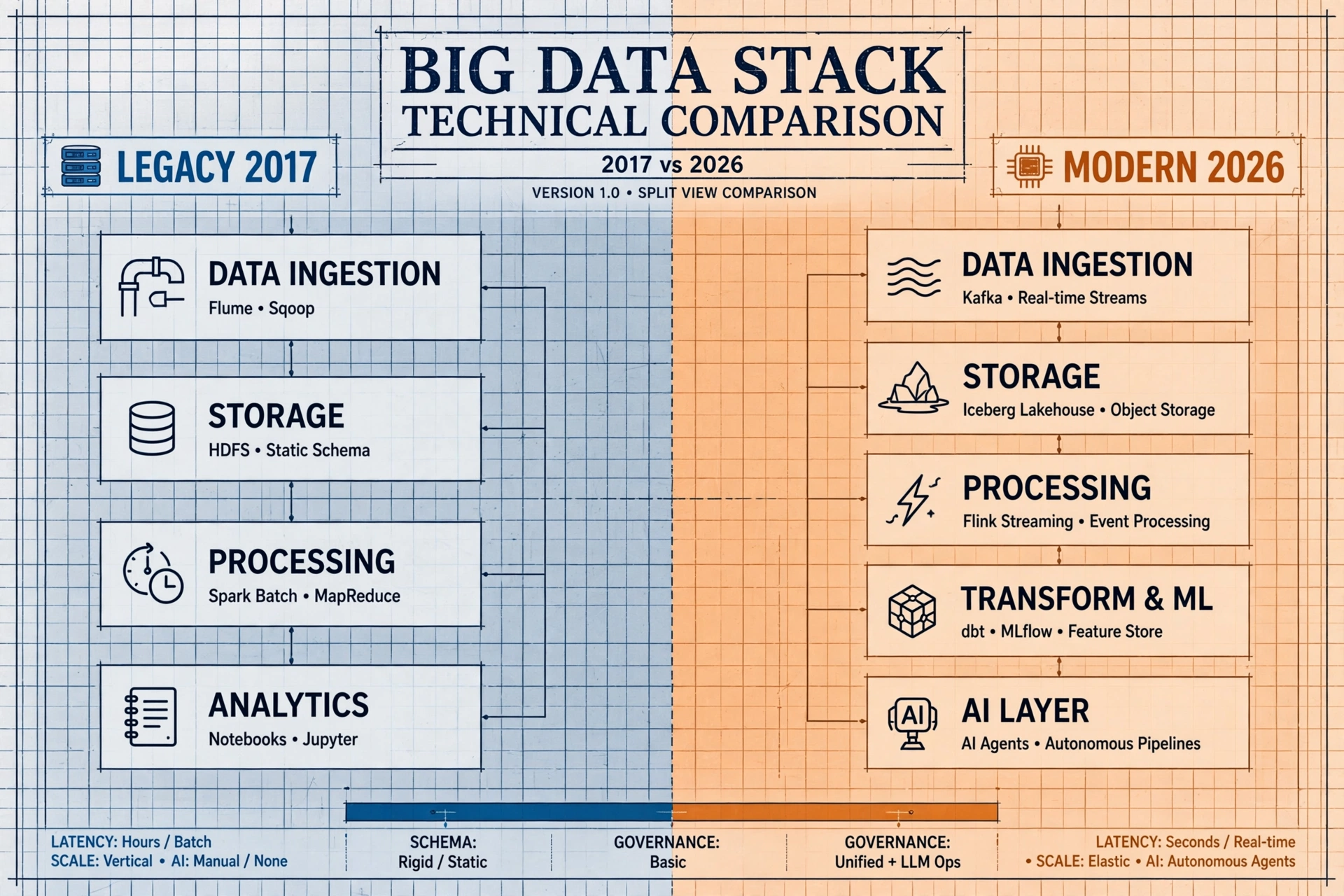
| Layer | 2017 (original article) | 2026 (BAOSS production) |
|---|---|---|
| Storage | Hadoop HDFS, Data Lake “swamp” | Iceberg/Delta Lake + Unity/OpenLineage Catalog |
| Processing | Spark batch, MapReduce | Flink SQL (streaming), dbt (transform), Polars (local) |
| ML/Ops | Notebooks → manual deploy | MLflow + Argo/Kubeflow + canary + automatic drift detection |
| Models | One-off models, manual retraining | Feature store (Feast) + automatic retraining + continuous RAGAS evals |
| AI in operations | BI dashboards | Autonomous agents (LangGraph/CrewAI/AutoGen) + MCP + RAG with guardrails |
Conclusion
The ten 2017 cases boiled down to “collect, store and visualise.” The 2026 cases are something else: systems that turn data into operating decisions in seconds, with agents that monitor, retrain, explain and act under selective human oversight. The value is no longer in having more data, but in the architecture that puts it to work: open lakehouse, feature store, evaluated RAG and agents with governance.
At BAOSS we close that gap with a 6-8 week time-to-value and audited metrics across more than 40 organisations. If your data is still stuck in notebooks and dashboards, what you are missing is not a bigger data lake.
Request your analytics diagnostic and discover how much value is in your data →