
What is AI in banking used for today?
The use cases with the highest return today are:- Fraud detection: models that analyse millions of transactions and detect anomalous patterns in milliseconds.
- Credit risk scoring: more accurate assessment of creditworthiness by combining traditional and alternative data.
- Anti-money laundering (AML) and KYC: automation of customer review and of suspicious transactions.
- Customer service: conversational assistants and generative AI to resolve queries and support agents.
- Process automation (back office): document reading, reconciliations and reporting.
- Personalisation: product recommendations and tailored financial education.
What does generative AI bring to banking?
Beyond predictive models, generative AI adds value in the synthesis of regulatory documentation, assistance to risk and compliance teams, report generation and developer support. Its adoption requires additional controls: verification of results, traceability and protection of sensitive data.What regulation affects financial AI?
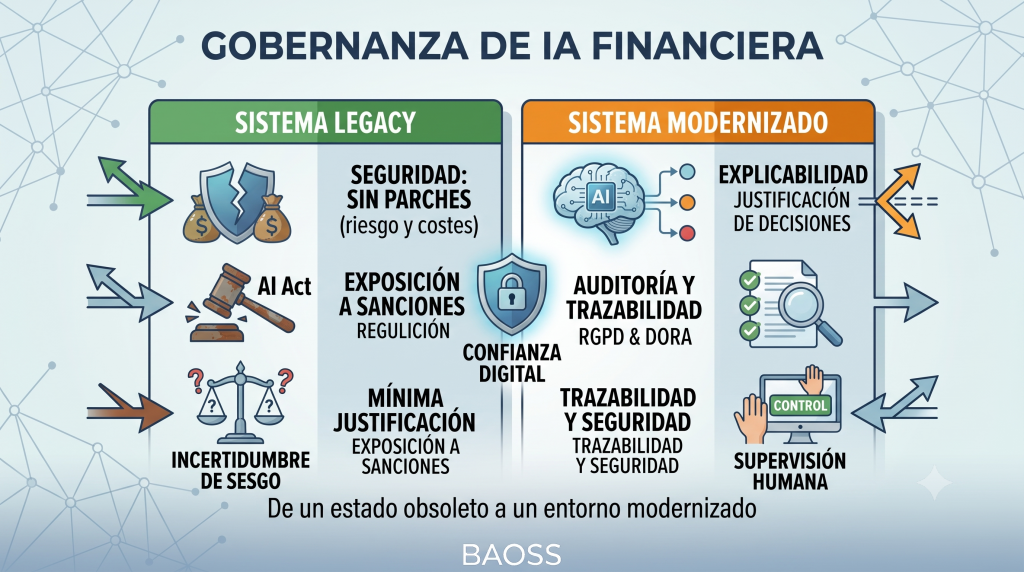
In Europe, any AI project in banking must consider:- GDPR: lawful processing of personal data and customer rights.
- AI Act: classifies many financial uses (for example, credit scoring) as “high risk”, with transparency, human oversight and risk management obligations.
- DORA: digital operational resilience and management of technology and third-party risk.
- EBA and supervisor guidelines on models and outsourcing.
How to adopt AI in a financial institution safely?
We recommend a phased approach:- Prioritise use cases by value and level of regulatory risk.
- Data governance: quality, lineage and access control.
- MLOps and model control: versioning, bias and drift monitoring.
- Explainability and auditability: document decisions and keep traceability.
- Controlled pilot before scaling to production.
FAQ
Will AI replace banking analysts? No, it assists them. It automates repetitive tasks and frees up time for analysis and the client relationship. Is it legal to use AI to grant credit? Yes, but it is usually considered “high risk”: it requires transparency, human oversight and the absence of discriminatory bias. What is explainability? The ability to justify why a model made a decision, essential before clients and regulators.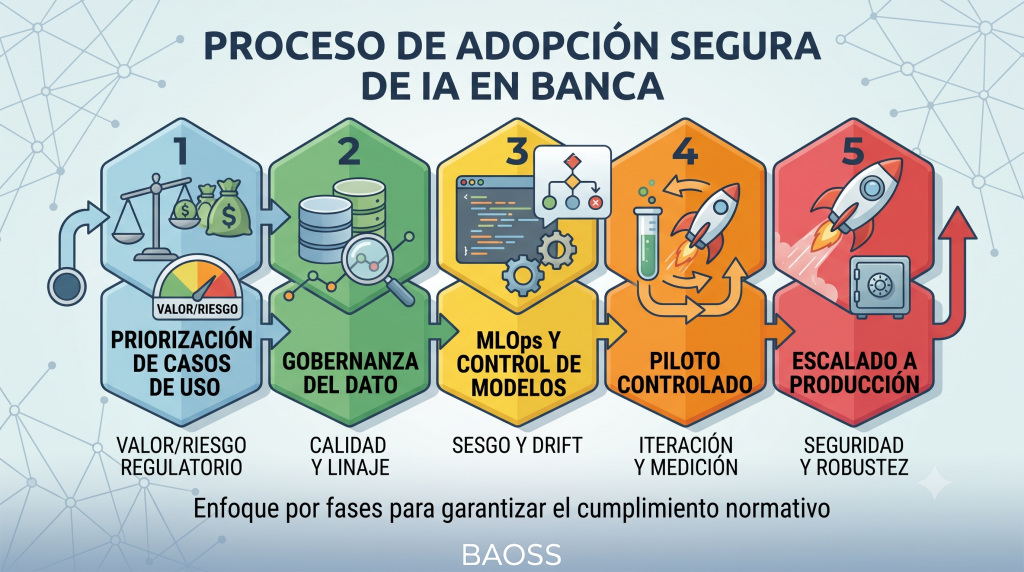
Want to apply AI in your institution with compliance guarantees? At BAOSS we combine experience in data, AI and the financial sector. Let’s talk.
Prefer to talk to us directly? Contact the BAOSS team and tell us about your challenge.