
What are the benefits of migrating to the cloud?
- Scalability: pay for what you use and scale on demand.
- Cost savings and control with a sound FinOps model.
- Security and continuity: backups, disaster recovery and managed updates.
- Agility: you deploy new solutions faster.
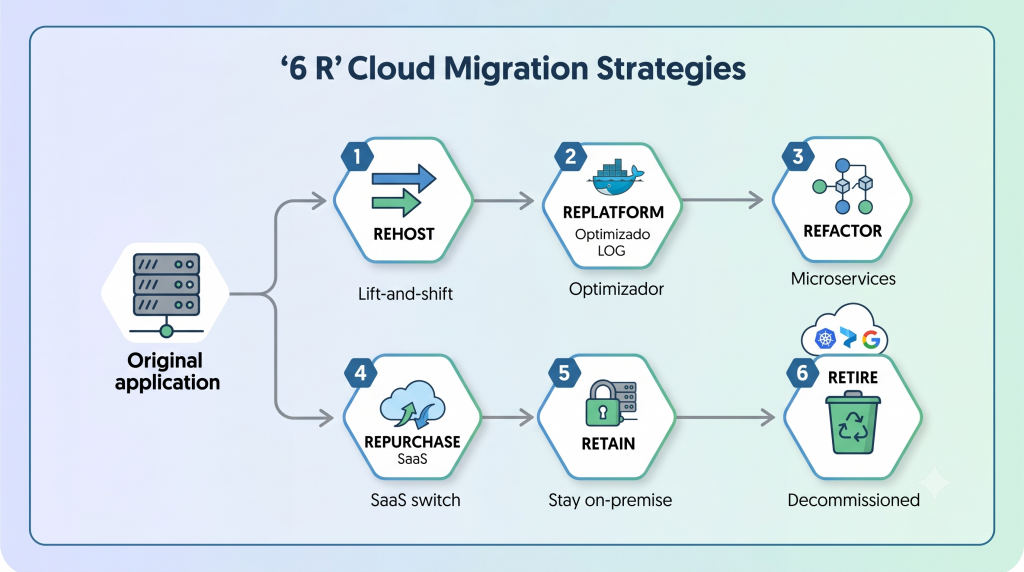
What migration strategies exist?
The well-known “6 Rs”:- Rehost (lift-and-shift): move as-is, fast.
- Replatform: small optimisations while migrating.
- Refactor: redesign to leverage the cloud (microservices).
- Repurchase: switch to a SaaS solution.
- Retain: keep on-premise what is not worth moving.
- Retire: decommission what is no longer used.
What are the phases of a cloud migration?
- Assessment: inventory of applications and dependencies.
- Strategy and design of the target architecture.
- Migration plan in waves, prioritised by risk/value.
- Migration and testing (data and applications).
- Optimisation of costs and performance (FinOps).
- Management and continuous improvement.
How much does it cost to migrate to the cloud?
It depends on the volume and the chosen strategy. The cost includes the migration itself and subsequent consumption. The key is a FinOps model from day one to avoid uncontrolled spend, the most common mistake after migrating.
Common mistakes to avoid
- Migrating without an inventory or prioritisation. Study use cases first.
- Lift-and-shift everything without optimising.
- Forgetting security and compliance.
- Not controlling costs from day one.
Frequently asked questions
Is migrating to the cloud safe? Yes, if it is designed with security in layers, encryption and access control. A well-managed cloud is usually more secure than many on-premise environments. Can I migrate without stopping the business? Yes. With wave-based migration and parallel environments, downtime is kept to a minimum. Thinking about migrating? At BAOSS we assess your infrastructure and propose the optimal strategy. Write to us.Prefer to talk to us directly? Contact the BAOSS team and tell us about your challenge.