
Kafka and ksqlDB: Real-time data streaming in service of the decision
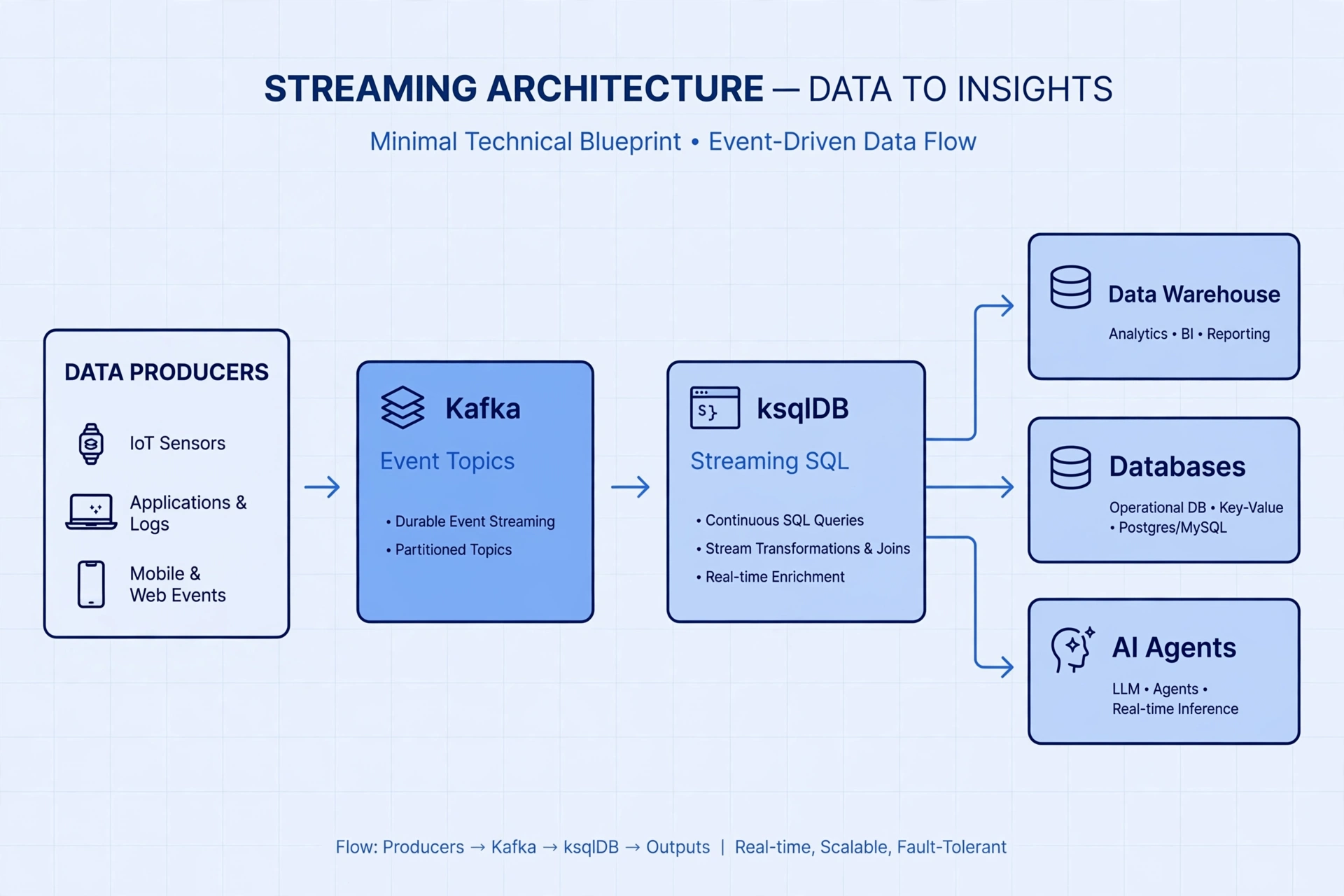
Companies no longer decide once a day: they decide in real time. Every order, every click, every sensor generates an event that, properly orchestrated, is a business opportunity. Autonomous AI agents depend on that flow. The Apache Kafka ecosystem has become the nervous system of that continuous operation, and ksqlDB lets you query it with SQL without writing a single line of streaming code. In 2026-2027, data streaming has stopped being an engineering curiosity and has become the foundation of autonomous AI agents and event-driven architectures. If you are wondering where Kafka ksqlDB streaming 2026 fits in your architecture, this guide summarizes real cases and best practices.
Kafka ksqlDB streaming 2026: what Apache Kafka is and why it matters
Kafka is an open source (Apache 2.0) data stream processing platform, originally created at LinkedIn to solve message queues at scale. Today it is the standard for moving events between on-premise and cloud systems: millions of messages per second with millisecond latency. Its partitioned, immutable log model allows multiple consumers to read the same stream at their own pace, which makes it ideal for event-driven architectures.
In the current context, Kafka does not just move messages: it feeds streaming lakehouses (Iceberg/Delta), feature stores for online ML, and autonomous agents that reason over events in real time. A well-governed cluster —with Schema Registry, CDC connectors and retention per use case— is the backbone of any modern data fabric.
The leap: from messages to queries with ksqlDB
ksqlDB is the streaming SQL engine built on top of Kafka. It turns topics into a living relational view that you can query, aggregate and join in real time. Its key advantages:
- Streaming SQL: you write
SELECTover live data streams, not over a static table. - No plumbing code: forget about bespoke Java consumers for every use case.
- Hot materialized views: aggregates that update themselves as events arrive.
- Native integration: connect with databases, topics and sinks through managed connectors.
- Time-windowed joins to detect patterns (fraud, anomalies, churn) over time windows.
3 enterprise use cases that already work
1. Telecommunications: live outage detection
A telecom operator correlates network events instantly to anticipate incidents before customers report them. With ksqlDB we aggregate the alarms by region and 5-minute window; an AI agent classifies the severity and triggers the remediation runbook. Result: MTTR -58% versus the batch reaction model.
2. Retail: real-time inventory and personalization
Every purchase updates stock levels and triggers recommendations within the same user session. The online feature store (Feast + Redis) is fed by Kafka topics, so the next-best-action engine responds in < 200 ms at the checkout and in the app.
3. Industry: predictive maintenance
Production line sensors (CAN-BUS, IoT) feed models that prevent stoppages before they happen. Telemetry travels through Kafka to a Flink/ksqlDB engine that computes health scores; an anomaly triggers an automatic maintenance order. Result: -67% unplanned stoppages and €820K/year in savings for a fleet client.
Kafka and your cloud architecture: the hybrid data fabric
Kafka acts as the data backbone between hybrid environments. It is the aggregation cluster that connects legacy systems with cloud services, enabling a data-in-motion strategy rather than just data at rest. Managed connectors (Confluent Connect, Kafka Connect) and the Schema Registry guarantee versioned data contracts between producers and consumers.
| Challenge | With Kafka + ksqlDB |
|---|---|
| Latency in decisions | Events processed in ms |
| On-premise / cloud silos | Unified event bridge |
| Development complexity | SQL over streams, no plumbing |
| Event governance | Schema Registry + versioned contracts |
| AI agents on live data | Topics as input for RAG and reasoning |
Best practices 2026-2027 (and mistakes to avoid)
- Define service level agreements (SLAs) per topic: freshness, retention and partition ordering according to the use case. Do not treat all events alike.
- Use Schema Registry from day 1: compatible evolution (
BACKWARD/FORWARD) prevents breaking consumers. - Combine Kafka with a streaming lakehouse (Iceberg/Delta) to have history and real time on the same layer.
- Do not use ksqlDB for everything: for complex transformations or day-long windows, Flink SQL or Kafka Streams give you more control.
- Govern the cost: poorly sized partitions and infinite retention inflate the cluster. Monitor with OpenTelemetry + VictoriaMetrics.
Data streaming stopped being an engineering curiosity to become a measurable competitive advantage. At BAOSS we take Kafka ksqlDB streaming 2026 to production with real-time data architectures that connect your systems to the decision of the moment —with governance, SLAs and audited ROI.
Want to move your data in real time and feed your AI agents with live events? Talk to our consulting team.
Prefer to talk to us directly? Contact the BAOSS team and tell us about your challenge.