
What is a legacy system and why is it a problem?
A legacy system is an application or infrastructure that is still in production but relies on obsolete technology: unsupported languages, on-premise servers that are hard to scale, or software nobody retains knowledge of anymore. Even if it “works”, it usually carries three risks: security (no patches), cost (expensive maintenance and scarce talent) and agility (every change is slow and risky).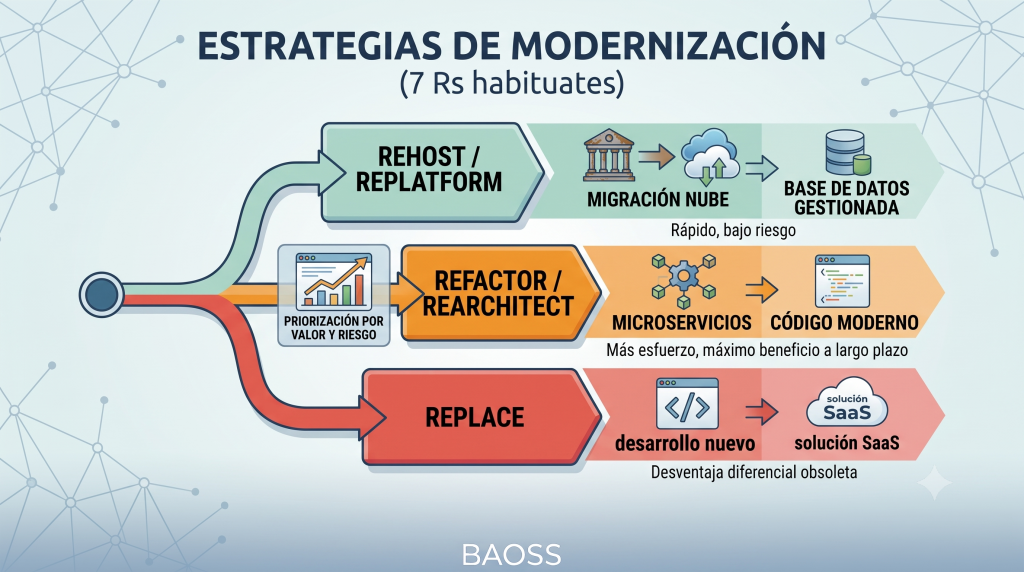
When is legacy system modernization worth it?
These are the clearest signs that the time has come:- Maintenance costs grow year after year and consume the innovation budget.
- The system does not integrate with modern tools (APIs, cloud, analytics).
- It depends on unsupported technology or vendors.
- Security and regulatory compliance are at risk.
- The business is asking for functionality the current architecture cannot deliver.
What modernization strategies exist?
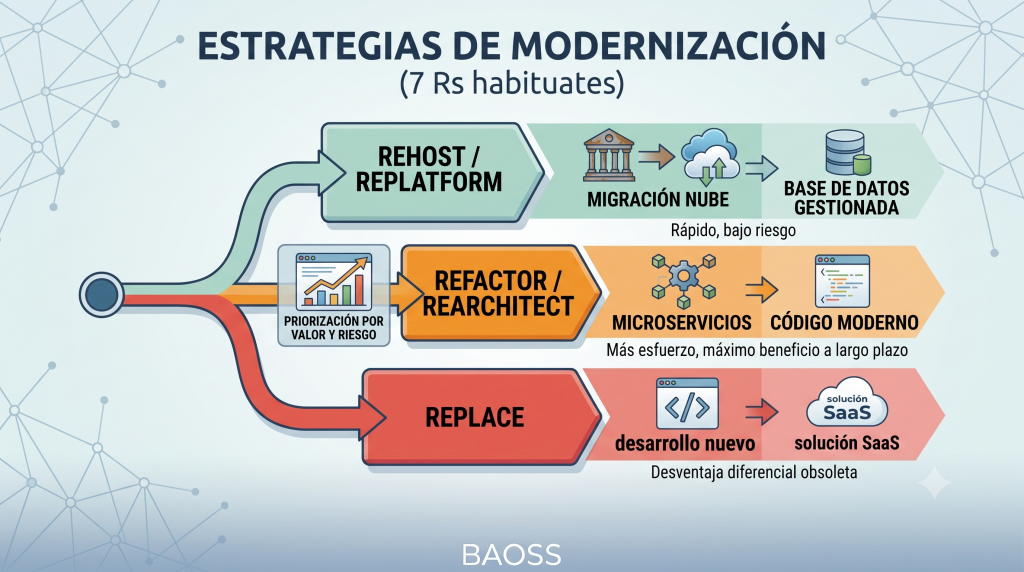
The “7 R” model is a good guide. The most common ones:- Rehost (“lift and shift”): move the application to the cloud without changing the code. Fast and low-risk, but it does not leverage cloud advantages.
- Replatform: small adjustments during migration (for example, using a managed database) to gain efficiency without rewriting.
- Refactor / Rearchitect: redesign the code toward microservices or modern architectures. More effort, maximum long-term benefit.
- Replace: substitute it with a SaaS solution or new development when the system no longer provides a differentiating advantage.
- Retire: decommission what is no longer used.
How to approach the project without slowing the business down?
At BAOSS we follow an incremental approach to avoid the dreaded “big bang”:- Initial audit: inventory of applications, dependencies and technical debt.
- Prioritization: a value-risk matrix to decide what to modernize first.
- Progressive strangulation (strangler fig pattern): replacing functions one by one while the old system keeps running.
- Automation and testing: CI/CD and tests to ensure nothing breaks.
- Change management: training the teams and documenting the new system.
How much does it cost and how long does it take?
It depends on the size and the chosen strategy. A rehost can be completed in weeks; a full rearchitect can take months. The key is choosing the right technology partner and measuring the return: lower operating costs, faster delivery speed and fewer incidents usually justify the investment within the first year.FAQs
Is modernizing always rewriting the system? No. In many cases it is enough to migrate to the cloud or refactor specific modules. Can I modernize without stopping operations? Yes. With incremental approaches such as the strangler fig pattern, the old and the new system coexist during the transition. Where do I start? With an audit that identifies risks and priorities; the roadmap is defined from there.Do you have a legacy system holding you back? At BAOSS we audit your architecture and design a legacy system modernization roadmap tailored to you. Let’s talk.
Prefer to talk to us directly? Contact the BAOSS team and tell us about your challenge.