
How can analysis with UX Analytics transform your website and lead it to absolute success?
After working for many years on various public and private portals, I was able to observe the results and benefits of an excellent user experience (UX) and user interface (UI). I was able to confirm that UX is what we want the person to feel when entering our website, while the UI is what we build and put on screen so that the user can feel it. The two things are complementary: it is impossible to have a good user experience without a good interface design (or plan). The continuous improvement of this design makes the experience of people much better. Therefore, UX and UI must go hand in hand to maximize the goals of any successful business.
What is UX Analytics?
User experience analysis is the measurement and analysis of people’s activity on a website or application that provides insight into how we can adapt its design to meet the current or changing needs of the people who use your web services.
Measurement can be quantitative and/or qualitative. Quantitative data measures what people do —such as clicking on a particular link— while qualitative data measures why they do it. Both types of data are crucial to perform an effective UX analysis.
However, it is important to stress that the data and the information they provide do not replace design intuition. Data can inform that intuition and help in decision-making but, ultimately, it is up to you to draw conclusions and make design decisions based on your own experience and knowledge of the person using your web services. That is where the benefit of this analysis lies.
Companies undergoing constant digital transformation should consider user experience analysis or even adopt it within their business model to provide more comprehensive support to their customers and meet the new demands of the market.
Success stories with UX Analytics
Spotify

In 2008, Daniel Ek created an App that would soon transform the music business: Spotify.
The idea was born from the union of its creator’s two passions: computing and music. It is an incredible success story, easy to use, offering an excellent experience, plus a fascinating repertoire of music, radio or podcasts. In other words: you will not have time in your life to enjoy everything it offers.
Its streaming service was launched a decade ago and has achieved undisputed success for years. The simple design of its mobile app leaves nothing to be desired compared with the desktop version, and both versions make use of these techniques.
The numbers are incredible. In 2020 it surpassed 300 million active users, of which 45% are paying subscribers. It tops the ranking, beating music streaming companies such as Apple Music, Deezer, YouTube Music and Amazon Music.
User experience analysis tools

Considering that some people look for these articles because they need a tool to help with their projects, I will share the following tools before going deeper into the topic:
- Quantitative:
- Qualitative:
- Heap (mobile)
- UXCam (mobile)
- Sessioncam (desktop)
- Hotjar (desktop)
There are hundreds of similar tools, but I am sharing a few examples and also a simple exercise of how you could apply them:
Imagine you have an app, and:
After using Google Analytics, you notice that most active users use an iPhone, even though both stores have the same number of downloads, Play Store (Google) and App Store (Apple).
What you do next is open Heap: you check how users behave on Android devices. After going through the session replays, you will notice that your app is not optimized for a large number of very popular Android devices.
With this, you can solve the problem.
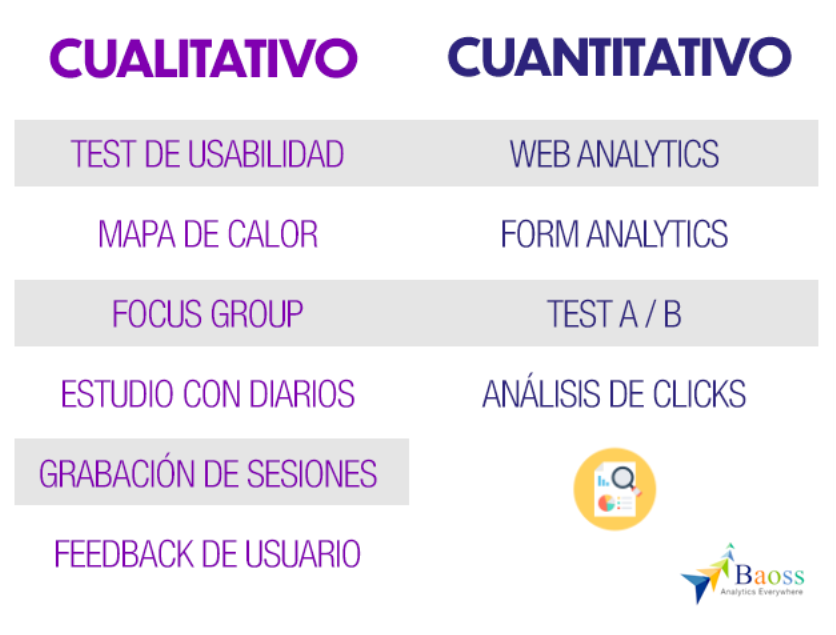
The table below distinguishes between quantitative and qualitative UX analysis methods.
At first you may feel overwhelmed by the number of methods presented to start your UX research; however, they are simple concepts that I can refine and expand on in a future article if you are interested in the topic. In the meantime, if you want to see how technological disruption is already affecting companies, this analysis of AI agents explains it well.
Personal experience
What I can share after years of experience in complex projects at large companies and web portals is that UX – User Experience is a very important point where brands must focus, in some cases even above sales. Why? Because all positive UX helps close a sale or, even more importantly, create a deep relationship with that user and turn them into a customer for life. Obviously, any company would want all its customers to advocate for its brands, and a great example of this is Apple, since it is the company par excellence to which many echo their various UX studies and their commitment to brand value.
To measure and identify how we can improve the UX of our services and systems for people, we must strongly consider the use of these techniques in our projects.
Adding a bit more to this article, I want to share with you a video I made on my YouTube channel talking about UX and UI with a very informal, different approach:
Reflection on interface as language and as a tool to support this analysis
From my perspective, the interface is precisely the set of possibilities for information, interaction and experience between people and systems. Some of these possibilities are offered by the system and others are created by people.
The interface should not be confused with the emerging phenomena it offers you. Information, interaction and experience are only possibilities. If a person is unable to use an interface, none of these events will come to light.
The graphical interface is the most visible part of the language. The use of metaphors in interfaces is just the tip of the iceberg. Beyond metaphors, there are other characteristic elements of human language: gestures, symbols, rituals, interactive genres and the ability to act symbolically in multiple contexts.
“Don’t make the user think, so let’s make it easy and simple”
Steve Krug
I like to think that the interface on its own is a language and not a message encoded in other languages. That is because I consider that an interface is not designed only by a designer, but also by the very user who uses it, customizes it, talks about it with others. It is also worth considering when the user refuses to use it. In other words, I consider the interface to be a social construction, as Steve Johnson says in the book: Interface Culture.
If we analyze the user interface (UI) under UX Analytics we can obtain incredible results, making our web project an absolute success in terms of results and user experience, contributing greatly to digital transformation in your business.
Prefer to talk to us directly? Contact the BAOSS team and tell us about your challenge.